Silvia Rivera, Director of Local News, writes about what we have learned in the first phase of our Local News Big Bet and the contexts and challenges communities face when they lack reliable information.
How do you get your news and information? Chances are that, depending on who you are, where you live, and a confluence of other factors, your answer will differ from the next person reading this. If there were a one-size-fits-all response, our Big Bet on Local News would be much easier to make.
As documented by The State of Local News, over the last two decades, we have continued to operate in an era of dynamic change. We anticipate that over the next decade, the ongoing closure of newsrooms across the country, continued attacks on press freedom, and shifting audience habits will persist, even as we continue making the case for local news as a public good. Good things never come easy, and we are doing everything we can to mobilize resources that help build durable, thriving information ecosystems. As of this writing, we have committed more than $185 million to this effort.
We are doing everything we can to build durable, thriving information ecosystems.
Our Midpoint Outlook
As we reach the midway point of our Local News Big Bet, we have been learning alongside our grantee partners, who represent diverse local news archetypes serving their communities in a variety of ways: independent digital newsrooms like LOOKOUT; collaborative journalism networks like Puente News Collaborative; and statewide accountability outlets like the Mississippi Free Press. They join dozens of legacy outlets in transition, community-driven newsrooms, creator and trusted messenger networks, and local information services.
Each represents what we see as a replicable and scalable model–or archetype–rooted in trust and community across our four Local News priority regions. Soon, we will share updated ecosystem snapshots that offers a common understanding of our work in Chicago, Central Appalachia, the U.S.-Mexico Borderlands, and key Southern states.
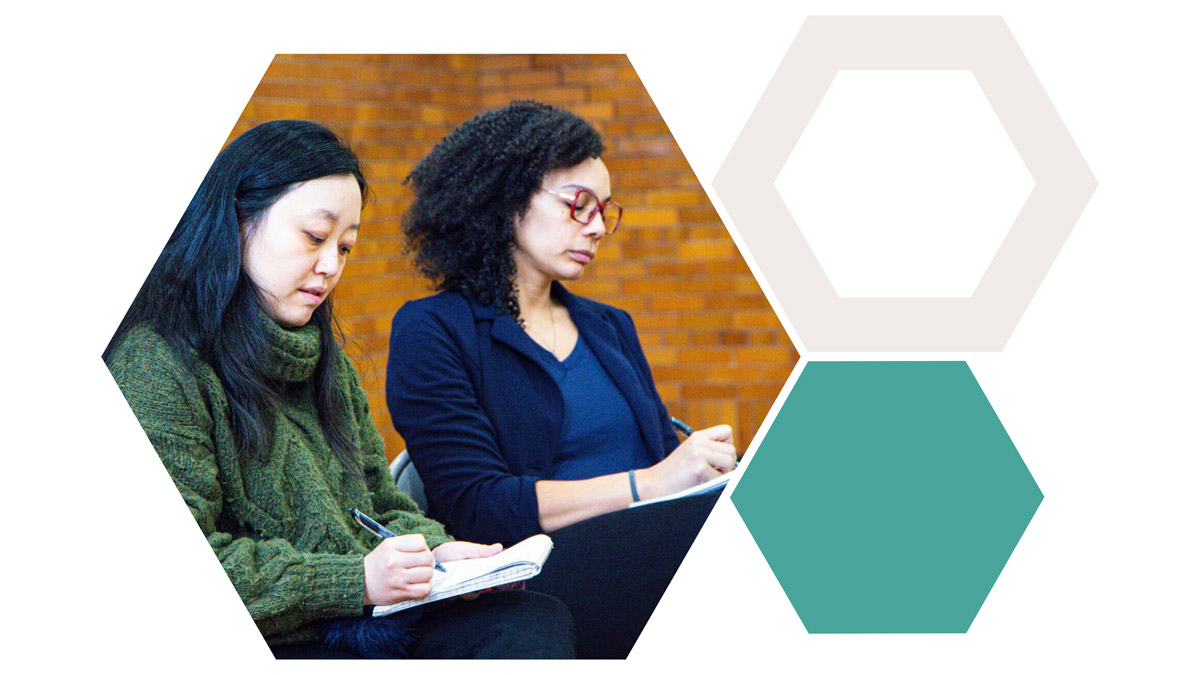
Illinois Answers Project journalists Binghui Huang, left, and Crystal Paul take notes during the newsroom’s community listening and media literacy session in 2025. Credit: BGA/Illinois Answers Project.
Providing this field context is important because, for funders, it is not enough to support brilliant leaders and newsrooms. We must do so with an understanding that the environments in which they operate face overlapping civic information, local journalism, and community vulnerability gaps.
As we have analyzed data from the Civic Information Index, developed by Listening Post Collective with the Information Futures Lab at Brown University, and the Local Journalism Index, developed by Rebuild Local News and Muck Rack, we see that communities lacking information across the country have compounding challenges. They are often also among the least insured, least food-secure, and least served by public health providers. We cannot address the question of local news sustainability without understanding this broader context.
Our strategy is guided by four approaches: Equity, Engagement, Infrastructure, and Visibility.
This is why, in practice, our Local News strategy is guided by four approaches: Equity, Engagement, Infrastructure, and Visibility. Equity and Engagement primarily support local news archetypes, the newsrooms and information providers doing the work of journalism. Infrastructure and Visibility strengthen the ecosystem around them through capacity building, coordination, policy, capital, and the conditions necessary for local news to thrive as a public good.
Our Long View
As we move closer to the end of the first phase of our Big Bet in 2028, we are, in many ways, still at the starting line of understanding what kinds of catalytic support can create the conditions for long-term sustainability and durability.
Next year, we will introduce an updated strategic framework that reflects our learnings over the last few years. We will work with our grantee partners to develop a field agenda for the next phase of this work and identify the pathways with the greatest potential to catalyze thriving local news ecosystems. We will also continue building alongside the coalition efforts of Press Forward. Local News is a Big Bet worth making.