







Long-standing, community news outlets—New York Amsterdam News, The Oklahoma Eagle, and El Tecolote—grow through a mix of innovation and staying true to their mission.
In the spring of 2024, communities living out of recreational vehicles in San Francisco were drawing unwanted attention. Neighbors complained of noise, littering, and “eyesore” conditions. They pressed city officials to force out the camper vans and their occupants.
People assumed they were nomads — until staff at bilingual news outlet, El Tecolote, knocked on their doors.
In a years-long series of stories, the paper brought to life the struggles of what turned out to be hard-working Latine families. The pandemic upended their livelihoods. They were navigating multiple jobs, gig work, and keeping their kids in school. The RVs were saving families from homelessness.
El Tecolote, Spanish for “The Owl,” is a free Spanish- and English-language news source that has covered city government, neighborhoods, and arts and culture since 1970, making it the longest-running bilingual newspaper in California. It is one of a number of legacy news outlets serving bilingual readers around the country that are thriving today through a mix of innovation and doing what they always have: placing community at the center of their coverage.
“Nobody’s telling our news, and we need to do it in our way,” El Tecolote’s Editor in Chief Erika Carlos said. “Only a Latinx community newsroom could do that story the way we did,” she said of the RV series, which changed the narrative around the community and led to a temporary reprieve in residents’ displacement.

“Nobody’s telling our news, and we need to do it in our way.”
Besides telling untold stories, the bi-weekly paper is reinventing itself. An ethnic studies professor started the paper as part of a college course. Since Carlos took over in February 2024, El Tecolote has expanded its digital presence on Instagram, YouTube, TikTok, and Facebook, and grown website visits by 53 percent. It also still appears in print, which, along with targeted WhatsApp groups and community events, is helping serve audiences such as day laborers, immigrant mothers, and street vendors.
To cultivate the next generation of bilingual community journalists, El Tecolote started a 10-week summer workshop series, News Hub, in June 2024. Other new initiatives include a series focused on mental health in the Latine community, which blends community news, resource guides, and a “Querida Consejera” column Carlos described as the “Latina Dear Abby.”
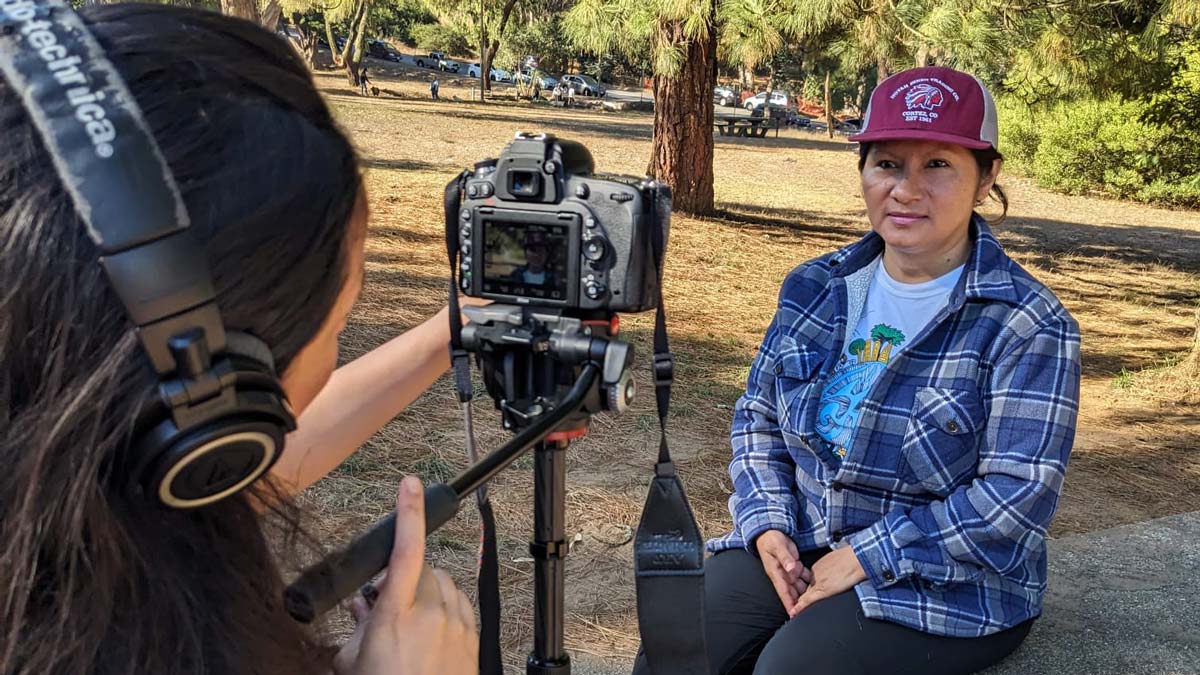
El Tecolote Editor in Chief Erika Carlos interviews Magaly Q. about how she began to embrace caring for her mental health and the practices she uses to support her mental wellness. Credit: Adriana Camarena.
During breaking news and election cycles, El Tecolote is often the only newsroom in the region making relevant information accessible to bilingual communities. When federal agents were deployed to the Bay Area—an order that was soon cancelled—El Tecolote was the only newsroom in the area delivering mobile live updates in Spanish. Through The Pueblo’s Agenda initiative, the news outlet invited readers to shape questions for city and county supervisor candidates in the 2024 election and presented the answers on several platforms.
“Some would call these informal, community solutions innovation. This is just survival.”
Without traditional means of support, El Tecolote has always depended on innovation and ingenuity. For decades, it relied almost entirely on a staff of dedicated volunteers and support from community members, including one who donated office space, and another, a bingo hall for the paper to generate revenue.
“Some would call these informal, community solutions innovation,” Carlos said. “We’re like, ‘This is just survival’.”
Today, philanthropic support and corporate sponsorships help the paper experiment and grow while it finds a new revenue strategy. El Tecolote introduced a membership model in 2025. The staff, now paid, is the largest in the news source’s 55 years. And its connection with readers is stronger than ever.
New Collaborations
That community connection has been central to other legacy outlets such as The Oklahoma Eagle, a weekly that focuses on Tulsa's Black community and is starting its own important new chapter. The Eagle’s husband and wife founders created the paper by salvaging equipment from the ashes of the 1921 Tulsa Race Massacre. Ever since, it has symbolized the rebuilding and empowerment of Black Tulsa.
In 2025, The Eagle joined the new nonprofit collaborative, Tulsa Local News Initiative, launched with $14 million in philanthropic support to build the capacity of trusted journalism in the area.

Gary Lee, Executive Editor of the Oklahoma Eagle and Tulsa Local News Initiative, is a former Washington Post and Time Magazine journalist who grew up in Tulsa. Credit: Tim Landes
The initiative was established after a year-long research and community listening effort involving more than 300 Tulsans in a diverse city home to the historic Black Wall Street district, Native tribes, a growing Latine community, and thriving businesses.
“My vision for this new nonprofit newsroom is that it be the publication that Tulsans say they want — more positive-spirited news, as well as looking at problems and challenges across the city, and seeking solutions,” Gary Lee, Executive Editor of both The Eagle and Tulsa Local News Initiative Executive, said in a promotional video.
The initiative is producing in-depth, nuanced local reporting under the name Tulsa Flyer. It is free to access and available to republish. Tulsa Local News Initiative also is investing in other newsrooms in the area, including bilingual and Black outlets.
Such collaborations are happening at other legacy newsrooms.

In New York City, the Amsterdam News, a weekly established in 1909, is one of 10 Black publishers that collaborated to launch a national news site in 2020 to engage and empower Black America. Called Word in Black, it was created from an idea that Amsterdam News Editor in Chief Elinor Tatum conceived.
The Amsterdam News has a storied legacy, chronicling everyday Black life in America in a way that few other outlets did, while refusing to compromise its ideals even if it meant being vilified.
It was among the first newspapers to publish Malcolm X, for example, and carried articles by W.E.B. DuBois and other Black leaders. It even claims to have published the term “hip-hop” for the first time in a publication in 1979.
Reaching Young People
Still, Amsterdam News’ leadership struggled to gain the attention of philanthropies whose investments in journalism have been essential in driving innovation in recent years. That has started to change.
“The investment has enabled us to create new paths that we, quite frankly, would not have been able to undergo without that (support),” Tatum said.
One of those paths is Blacklight, the first investigative unit at a legacy Black newspaper, which Amsterdam News launched in 2022.
Blacklight’s reporting has shown how racial bias in medicine is causing an overdiagnosis of schizophrenia in Black patients. It has linked rising temperatures from climate change to an increase in city gun violence. Blacklight also led to changes in the way Amsterdam News staff cover topics such as urban violence, which it now examines through an emphasis on root causes and solutions.
“We’ve got to continue to be relevant, and we’ve got to figure that out.”
As she looks to the future, Tatum is focused on continued innovation and, especially, reaching younger people, who she said are an “enigma for many news outlets.”
“We’ve got to continue to be relevant, and we’ve got to figure that out,” she said. Through collaboration and taking chances, she is sure they can succeed.
“We always say that we're a legacy newspaper with an entrepreneurial spirit,” Tatum said.
As part of its Local News Program, MacArthur in 2024 provided individual, $350,000 grants to the Amsterdam News Educational Foundation to support the charitable and educational initiatives of the New York Amsterdam News; The Oklahoma Eagle to support its charitable operations and help ensure its sustainability as part of the Tulsa Local News Initiative; and El Tecolote to support the free, bilingual news source for readers in the San Francisco area.