






WYSIWYG
Essay by John Palfrey, President
April 7, 2026
Before my time in philanthropy, I had the privilege of serving as a head of school for ninth to twelfth grade students. One of the great joys of that role was designing and teaching a small elective seminar we called “Hacking.”
Each class meeting, 12 students and I would study infamous data drops. We discussed the ethics of WikiLeaks disseminating footage of civilian deaths in Iraq and Afghanistan. And we dissected the decision by the hacker collective “Anonymous” to cyberbully members of the Westboro Baptist Church after the hate group threatened to picket the Sandy Hook school shooting victims’ funerals.
But like most areas of study, the core of the course was about the future we choose to create as much as it was about analyzing those discrete past events. I hope that if you asked my former students what they recall from the elective, they would remember this idea: what exists today is not inevitable. If something is not working, you can tear it down, so better ideas can rise from the rubble.
That, after all, is the ethos behind some flavors of hacking: wreak havoc, cause chaos, and then once the dust settles, start building something better in place of whatever was destroyed.
Today, we are over-indexed on the first half of this equation. Systems are crumbling all around us, whether they are intentionally destroyed or disintegrating under the weight of what is being asked of them.
We see it in our own backyard in Chicago, where we have spent the past several months working with grantees and our community to reinforce the rule of law when its own enforcers ignore it.
We see it on the West Coast, where lives are upended and infrastructure collapses when communities like Altadena and the Pacific Palisades are consumed by wildfires, and on the East Coast, where communities in the Carolinas can be slammed by a snowstorm even as they are still rebuilding from a late summer hurricane.
We cannot forget that in a democracy, we are not passive observers.
We see it when the information systems that are supposed to keep our global community connected start to crumble, when polarization makes it difficult to talk to one another, when censorship makes it impossible to find the truth, when innovation in AI threatens to destroy more jobs and more lives than it will create and improve.
Things can feel out of our control. But we cannot forget that in a democracy, we are not passive observers. We are players in a game with real stakes. Each one of us has agency in our democracy.
We will decide our future by how we react to these disruptions and reexamine the systems that fail us, so we can reimagine a safer, freer future.
We should not get stuck in lamenting our inability to prevent the past or avert destruction that has already happened. We can, however, seize the opportunity and obligation to build something better in its place.

React
At MacArthur, we have shown that we are unafraid to support people who tackle timely problems, even in the face of risk or uncertainty. This was true during the pandemic and is true today. Though philanthropy can be slow to act in such unstable circumstances, in 2020 we acted quickly. MacArthur distributed $125 million in bonds that simultaneously addressed two compounding crises: COVID-19 and structural racism.
The pandemic was a sudden, shocking event. It also exposed longstanding systemic inequities. We saw how our healthcare institutions served White and well-off patients better than people of color and people with fewer resources. We saw how uncertainty fueled vaccine skepticism and undermined public health. We saw how pervasive racial violence spurred a movement for accountability. And our physical separation in our houses and apartments only deepened social and political divisions, pushing debate to often-anonymous and etiquette-free corners of social media.
We are unafraid to support people who tackle timely problems, even in the face of risk or uncertainty.
Our Equitable Recovery Initiative funded research on the virus and vaccine, got resources to the communities hardest hit, supported democracy and civic engagement, and invested in new ways of thinking and working to better serve communities.
That decision not only saved lives but better positioned us to respond to future challenges. Our reaction pushed us to disrupt our own organizational practices. We adjusted our ways of working to balance agility and collaboration: we worked broadly across departments, incorporated perspectives from external advisors who represented impacted communities, and reduced burdens on grantees.
Our immediate solutions did not solve the systemic issues. But when you face a crisis like COVID-19, you do not have time to wait for the perfect fix. You move fast, make decisions, and adjust as necessary. To be clear: we borrowed money so that we could give it away, and we are still paying back that debt each year. And given the same circumstances, we would immediately make the same choice.
We are in a similar period now in too many ways, and over the past year, we have taken a similar approach. We are responding to new, manmade crises: Chicago and so many American cities have been unlawfully attacked by federal agents, and our communities are reeling from drastic funding cuts and claw backs in global aid.
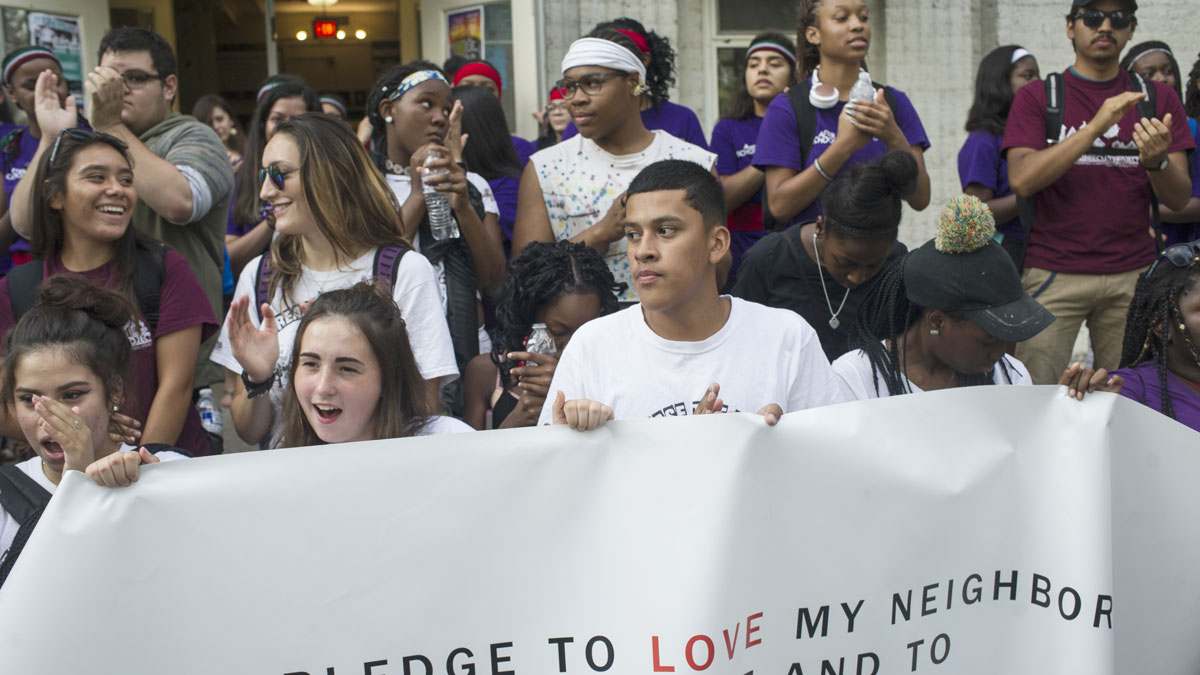
Teenagers from the Back of the Yards, Englewood, Woodlawn and other neighborhoods representing The Resurrection Project, After School Matters and other organizations gather outside the Hamilton Park Field House.
Our reaction was to commit to do more and raise our charitable payout for at least two years. We asked more of our Staff, we collaborated with our peers, and we listened to our grantees. We are honoring our commitment, so we can help our communities, our country, and our planet weather the latest storms. We have made grants in areas where we do not typically work—funding food insecurity and community needs that have become acute amidst the wreckage and havoc of the past year. Tomorrow, we will be prepared to pivot to the next pressing need.
We hope that when we take on these challenges, we set an example that encourages our peers to join us in the arena. That is a responsibility we take seriously, and it informs both when we speak up and how we do so.
Our work goes far beyond simply responding to the situations in front of us, and our highest purpose cannot be pursued with a defensive posture. The only position from which one can design a better, freer, fairer world is on offense: by working toward a shared vision.

Reexamine
During an emergency, we tend to focus on avoiding the worst possible scenario. We patch over problems as they pop up. We prevent further losses and stop the bleeding. That work is crucial in a crisis. But these reactive solutions do not solve the fundamental issues that caused the failure in the first place, and they fail to raise the bar for the future.
We must do more than respond to issues as they arise. We also have an obligation to identify what made our systems so fragile in the first place, so we can better protect ourselves moving forward.
This is where we reexamine: What does this system need to do, and where is it failing to meet the mark?
We need to ensure history is not erased. And we must acknowledge that our current story is incomplete and extend more invitations to craft the next chapter.
We need to keep local newsrooms up and running. We can also help independent news outlets identify their business challenges and change their modes of operating.
We need to protect people from what can feel like constant climate disasters. We can also address the root causes of climate change, so hurricanes, fires, and freezes become less frequent and less devastating.
We must acknowledge that our current story is incomplete and extend more invitations to craft the next chapter.
We need to grasp how the rule of law has come under such direct attack. And we need to prepare the new safeguards that will prevent these excesses from ever recurring.
That is why MacArthur proactively assesses the most essential structures of our society and explores how we can make them stronger and smarter. We support the people who show another way is possible.
When leaders try to rewrite the historical record, we find and support organizations that look for new ways to preserve and share our history—like StoryCorps, which collects all kinds of anecdotes from every kind of person to create a more complete understanding of our country.
StoryCorps - Brooklyn, New York - captures, shares, and archives stories of a diverse range of Americans for future generations.
When local papers shutter, we find and support journalists seeking new ways to reach their audiences—like the reporters at Invisible Institute and City Bureau, whose small, startup newsrooms in Chicago collaborated on Pulitzer Prize-winning investigations, affirming their belief that their local community was worth covering.
When climate disasters threaten to destroy our neighborhoods, we find and support groups like the Climate and Clean Energy Equity Fund, which creates a network of trusted, local environmental organizations and helps them advocate for policies that benefit everyday people with a single, strong voice.
When we reexamine, we can create something even better than what we had before.
Sometimes, there are catastrophes like COVID-19 that catch us completely off guard. Much more often, there are signs that things are failing, or whistleblowers within organizations willing to call out bad behavior. Why wait for the emergency when we can avoid it altogether?
We cannot accept our broken systems. Nor do we have to revert to the status quo. When we reexamine, we can create something even better than what we had before.

Reimagine
The world is blessed with visionary and creative people who think three steps ahead of the rest of us. One part of MacArthur’s work has been finding and funding them.
This is especially important today. The destruction all around us has left vacuums and voids. Who will fill those gaps? As a Foundation, we can find and empower people who are generous, ethical, and innovative to be the architects of the next era.
MacArthur has always nurtured the innovators on the cutting edge of the next big thing. Our MacArthur Fellows Program is famous for finding talent across every discipline, because we are willing to play the long game.
In 1981, as part of the first class of MacArthur Fellows, we supported Professor Henry Louis Gates, Jr. long before his groundbreaking work on genealogy and genetics made him a household name. That same intention led us to support human rights lawyer Bryan Stevenson long before the Equal Justice Initiative scaled its reform and justice work and established the Legacy Sites; fiction writer Chimamanda Ngozi Adichie long before she published Americanah and gave the talk “We Should All Be Feminists,” which was sampled by Beyoncé; and visual artist Jeffrey Gibson years before his solo show in the United States Pavillion at the 2024 Venice Biennale.
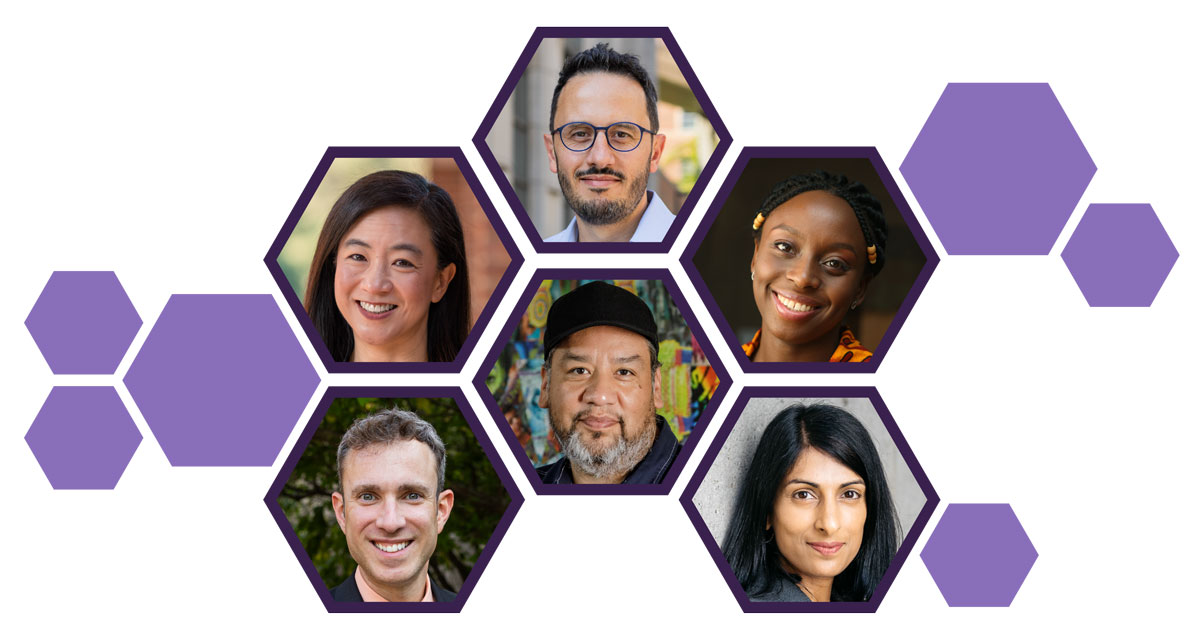
That is the beauty of this program: we do not know what the Fellows will do in the future, but we know it is likely to be creative and effective. That applies to the contributions and accomplishments of the 2025 class, which includes atmospheric scientist Ángel F. Adames Corraliza, neurobiologist and optometrist Teresa Puthussery, nuclear-security specialist Sébastien Philippe, and political scientist Hahrie Han.
A surprise call informing someone that they have been named a MacArthur Fellow can change a life overnight. But the big, ambitious ideas we need to change our future for the better take time. When we find people who dream in decades, not years, we support them, study their success, and help scale their strategies.
The big, ambitious ideas we need to change our future for the better take time.
The future is unknown and unknowable. This is especially true at a time of upheaval, of rapid technological change, of shifting policy and funding landscapes. But we have plenty of power to put our thumb on the scale. We will not win every bet, but MacArthur will be there to support the people taking chances and building from the ground up.
This is in our DNA. As a Chicago-based philanthropy, we have deep roots in our community. We do everything we can to be good neighbors. We know that local leadership is essential, and working across sectors—with nonprofits and charitable organizations, government, business, and faith leaders—allows us to scale our ambitions. And it is because we are good neighbors that we can make an impact globally. Wherever we work—from Abuja, Nigeria, to New Delhi, India—we can collaborate with the individuals and organizations that have the trust of their communities and the skills to achieve their goals.
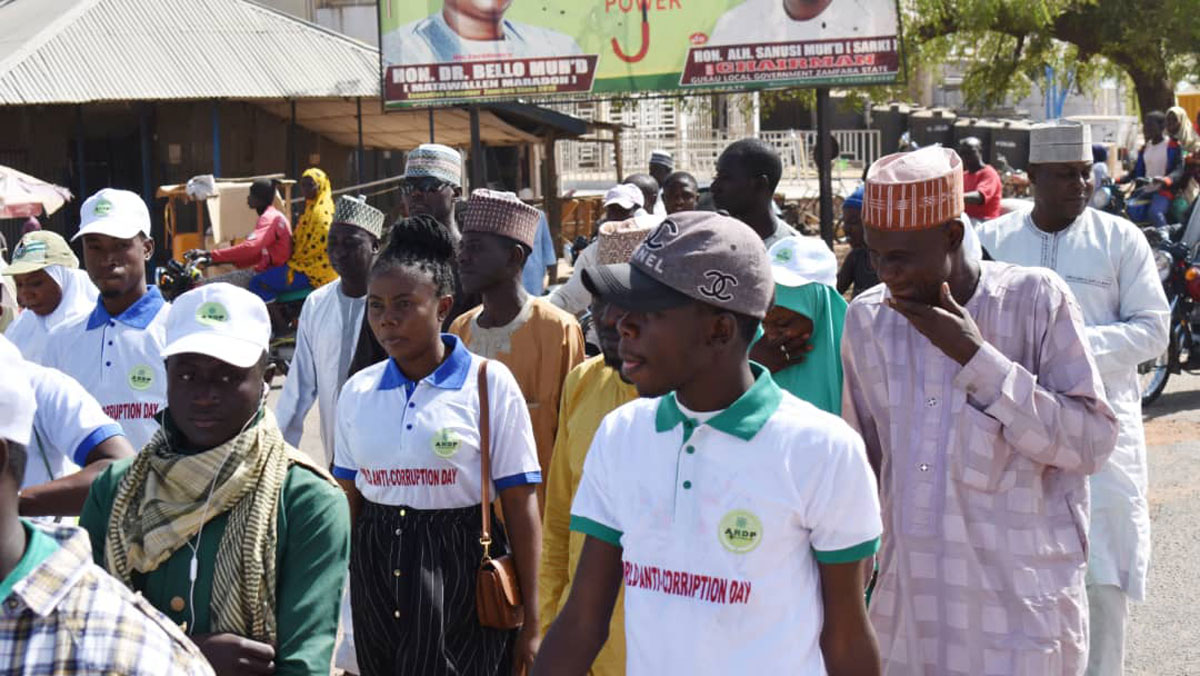
Nigerians gather for a state-wide rally to mark Worldwide Anti-Corruption Day.
We have agency. We have choices.
While we cannot ignore what is right in front of us, we must also keep our focus on the horizon. We at MacArthur are looking both near and far, addressing what is happening today so that we can be better prepared for tomorrow. It is our fond hope to continue to work with long-standing partners as well as new friends, especially people who come from different backgrounds and experiences than ours. We are inspired to help create a "Bigger We" along with our philanthropic partners. We will continue to proactively reexamine our world to identify what it needs and reimagine the kind of future we can build—not from the sidelines but as players on the field.

Rebuild
The most fun conversations in my hacking course were not about the gritty, made-for-Hollywood data leaks or espionage. It was when I got the chance to watch a room of teenagers dream up a better world than the one they inherited. They were not scared to abandon the status quo. They saw the opportunity to build something better. They were not scared about that; they were positively excited about that prospect.
The teenagers in my course were a few months away from graduation and college. They did not feel like the world was happening to them: they knew they were about to happen to the world. No matter our age or when we last crossed a graduation stage, that can still be true for each of us.
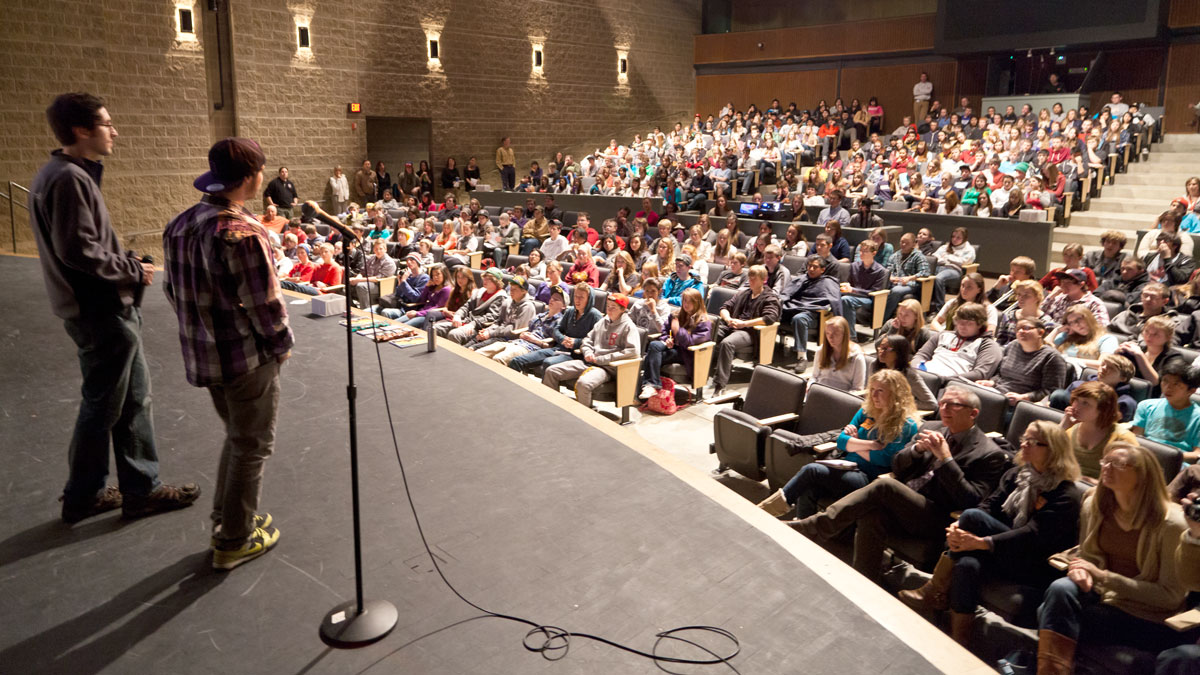
Members of the Action for the Climate Emergency activate young people by presenting an introduction to climate science at an all-school assembly followed by on-site voter registration.
AI presents all of us with one of those challenges right now. The future of AI often feels like it is happening to us, but we are its designers, users, creators, and architects. Humans can still shape whatever AI becomes, where it fits in our world, and what systems it tears down.
As someone who has dedicated a significant portion of my career to studying how we use technology and data to learn, govern, and work, I see boundless potential in this technology to improve our lives and create economic opportunity across all kinds of industries.
We will be part of the building and the rebuilding, through its many iterations.
But I can also see the world right in front of us: one where AI is often used to replace human thinking instead of improving it; where its common outputs are deepfakes, disinformation, and plagiarism. We can accept whatever algorithm wins the AI arms race because it is the most addictive or makes the most money. Or we can commit to building these tools to ensure they serve all of us.
At MacArthur, we exercise our agency, even when it is hard. We will be part of the building and the rebuilding, through its many iterations.
There is so much out of our control. Despite our best attempts, the world will inevitably tear down things we take for granted. That will always be an obstacle.
But we are under no obligation to accept our current circumstances. In fact, I think our obligation is to improve upon them, whenever we can, however we can.
Let’s lean into our proven abilities to solve problems in our communities. Let’s imagine what could be. And let’s build something better, together.
I invite your comments, suggestions, and critique, with special appreciation for a candor that will challenge us to achieve greater clarity, humility, wisdom, and impact.
Please Share Your CommentsMore Annual Essays
Returning to Fundamental Truths, Building an Inclusive Future
Returning to Fundamental Truths, Building an Inclusive Future
Essay by John Palfrey, President
Building Trust and Strengthening Democracy
Building Trust and Strengthening Democracy
Essay by John Palfrey, President

Stay Connected
Sign up to receive updates on our work