
As part of the Safety and Justice Challenge, Cook County has used an array of approaches to safely reduce local jail populations and address racial and ethnic disparities in the local criminal justice system.
Gregory Ozier wanted to make a difference for people in his community, so he joined a fellowship cohort of people impacted by the justice system. The group worked with community organizations and representatives of criminal justice agencies in Cook County, IL to understand the system and make recommendations to reform it.
“It was an eye-opening experience that gave me an opportunity to see how the system works,” he said.
Today, Ozier is a case manager at a nonprofit organization working with individuals who have spent time in jail.
“I get to use this knowledge [from the fellowship] to help educate and help guide [people] so they don't find themselves in positions to have to go through the judicial system,” Ozier said.

Greg Ozier, left, worked with community organizations and others to reform the criminal justice system. Credit: Laura Grossman
The benefits of his work with Cook County are an indirect but important example of meaningful change that the Safety and Justice Challenge (SJC) has helped drive. One of more than 100 participating cities and counties across the U.S., Cook County has used a wide array of approaches to safely reduce its local jail populations and make the local criminal justice system more fair by working to address racial and ethnic disparities.
Testing Local Solutions
One of the biggest changes in Illinois’s criminal justice system in recent years is the Illinois Safety, Accountability, Fairness and Equity-Today (SAFE-T) Act. Enacted in 2021, the SAFE-T Act ended cash bail statewide, instructing judges to detain individuals in jail based solely on public safety and flight risk, rather than their ability to pay. The law also called for expansion of pretrial services and additional training for law enforcement officers in areas such as use of force, crisis intervention, de-escalation, implicit bias, and racial and ethnic sensitivity.
Cook County’s work under the Safety and Justice Challenge helped pave the way for this statewide law by demonstrating that pretrial incarceration could be reduced and cash bail eliminated without jeopardizing public safety. Research from Loyola University Chicago found that bail reform in Cook County in 2017 had no effect on new criminal activity or crime in the years that followed.
Cook County has used a wide array of approaches to safely reduce its local jail populations and make the local criminal justice system more fair…
Other changes in Cook County practices as part of the SJC include reducing missed court appearances by sending court date text reminders and creating a jail population review team comprised of members from the offices of the Public Defender, State’s Attorney, Chief Judge, and County Clerk. Together, the review team addressed pretrial release processes and systemic problems that could be resolved through collaboration.
Cook County also made improvements in their efforts to divert people away from jail, including the Supporting Employment and Education Development program, which helps individuals charged with felony drug distribution seek living wage employment.
One of the more visible impacts of all those efforts occurred at the Cook County Jail. As of April 2026, the county decreased its jail population by about 30 percent since joining the SJC in 2016.
Statewide, jail populations as of August of 2025 were down 7 percent compared to before the SAFE-T Act, said Ahmadou L. Dramé, Director of the Illinois Justice Project, an organization that advances policies and practices to reduce violence and recidivism and make the legal system more equitable.

Cook County Chief Judge Charles Beach, center, background, congratulates young adults who have completed the SEED Deferred Prosecution program and prepare to have their cases dismissed in November 2026. Credit: Laura Grossman
Cara LeFevour Smith, Director of the Office of Statewide Pretrial Services added that, “There's been a seismic shift in the way the pretrial period in Illinois, specifically Cook County, looks and feels to defendants and their families and to stakeholders.” The Office of Statewide Pretrial Services was created by the Illinois Supreme Court in 2021 following the enactment of the SAFE-T Act and now serves 84 Illinois counties.
Before the SAFE-T Act, monetary bonds were used frequently in Cook County, said Ali Abid, Deputy Director of the Cook County Justice Advisory Council.
“When we started this process, we were well behind large urban jurisdictions in the country,” he said, “and now we are a leader, in terms of reforms. We went from having the most and highest use of monetary bond to being the first state in the country to abolish monetary bonds.”
Efforts in Cook County reflect local solutions being tested across the country. Those include programs that expand community-based treatment; offer training for police, probation officers, prosecutors, and judges; and divert people from the criminal justice system who are determined by the courts to not be a public safety risk.
Origins of Reform
Local jails—intended for people who pose a flight risk or threat to public safety while they await trial—often house many individuals charged with nonviolent offenses and people who remain in custody simply because they are too poor to post bail.
Research shows that overuse of pretrial detention destabilizes families and communities. Even a few days in jail can limit people’s ability to get a job, worsen their health, and increase the likelihood of repeat incarceration.
The research also indicates that the overuse of jails disproportionately hurts communities of color, people with low incomes, people accused of nonviolent crimes, and individuals with mental illness.
Reforming a system as complex as the criminal justice system involves changes at every level and requires collaboration between many players.
Those conclusions prompted the MacArthur Foundation in 2015 to create the Safety and Justice Challenge by funding 20 diverse communities across the U.S. to find evidence-based ways to create fairer, more effective justice systems largely through decreasing pretrial detention and eliminating racial disparities. Dozens of other communities have since received funding or guidance from experts.
Reforming a system as complex as the criminal justice system involves changes at every level and requires collaboration between many players.
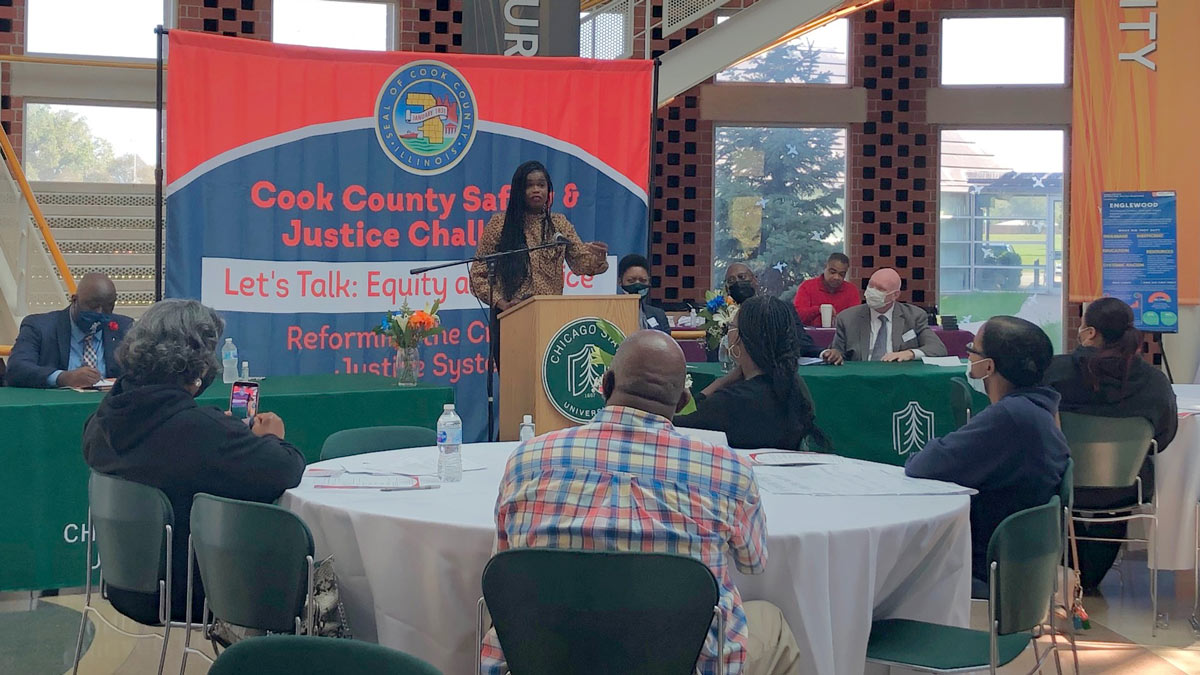
Then-Cook County State's Attorney Kim Foxx speaks to residents at a Safety & Justice Challenge community engagement in October 2021. Credit: Laura Grossman
The SJC encouraged various officials and government agencies to work together and supported the infrastructure to do so, the Illinois Justice Project’s Dramé said.
Without SJC resources, Dramé said, advocates would have been unable to advance reforms or respond to sustained efforts to reinstate cash bond and rescind improvements to pretrial incarceration.
“We were able to develop a statewide network of advocates and policy experts who could research, design, and educate the public about how to achieve the goal to reduce the jail population and respond directly to misinformation campaigns,” he said.

Justice Advisory Council staff and residents talk with Cook County Chief Judge Charles Beach at a 2025 community engagement event for the Cook County Racial Equity Cohort. Credit: Laura Grossman
Constant Evaluation
Racial disparities and opposition to justice system improvements are ongoing issues in Cook County and across the nation, Cook County Justice Advisory Council Executive Director Avik Das said.
Ongoing coordination among stakeholders to monitor and sustain reforms is critical to their success and to avoid unintended consequences, Das said.

“We have to be vigilant about assessing what's working, what's not, what needs to be tweaked, what needs to be strengthened, and what needs to be loosened…”
“As stakeholders in a system that affects people's liberty,” said Smith, “we have to be vigilant about assessing what's working, what's not, what needs to be tweaked, what needs to be strengthened, and what needs to be loosened—not in a knee-jerk reaction, but by constantly examining data on the services we deliver.”
Since launching the Safety and Justice Challenge in 2015, MacArthur has provided more than $400 million to local communities and organizations participating in the SJC, including more than $6.1 million to the Circuit Court of Cook County and more than $1.5 million to the Cook County Justice Advisory Council.