


Summary
National discourse on mass incarceration largely centers around state and federal prisons and tends to overlook local jails, where over-incarceration often begins. Jails are intended to detain people awaiting court proceedings who pose a danger to public safety or a flight risk. Yet with 7.6 million admissions a year in 2026, America's jails hold many who are neither.
A close examination of the jail population reveals troubling patterns that underscore the need for reform. Approximately three in four individuals held in jail in 2026 were legally presumed innocent, either awaiting trial, negotiating a plea, or unable to afford even modest bail. Nearly three quarters of people in jail are held for nonviolent offenses, including traffic violations, property crimes, drug offenses, and public order infractions. Research demonstrates that even a short period in jail can lead to loss of housing and jobs, strain on familial relationships, and more challenges that can undermine community safety.
Moreover, jail incarceration falls disproportionately on individuals with low income, people facing mental health or substance use challenges, and communities of color. Across the country, Black, Indigenous, Latine, and other people of color are over-policed, over-charged, and over-incarcerated compared to White people. Human rights and dignity are being denied.
In response to these issues and in partnership with a vast network of communities, experts, and advocates, the Criminal Justice Big Bet worked to safely address over-incarceration and racial and ethnic disparities between 2013 and 2026.
Our Approach
Through the Safety and Justice Challenge (SJC), we invested in local strategies, research, innovation, and communications to create national demand for criminal justice reforms that would safely reduce the number of people in jail and reduce racial and ethnic disparities. From 2013 to 2026, we made 537 grants totaling $411 million.
In partnership with local community advocates, people with lived experiences of the criminal justice system, and individuals who work within the criminal justice system, participating counties and cities designed creative, collaborative, and evidence-based solutions to make local justice systems more fair, effective, and efficient. Many of the nation's leading criminal justice organizations provided expert guidance, data analysis, and other support to SJC communities.
These cities and counties’ work highlighted the misuse of jails; how local criminal justice systems perpetuate historical racial injustices; and ways communities can meaningfully address these problems. It also revealed what it takes to build communities that are safe for everyone, including more effective methods to manage and mitigate safety risks without resorting to incarceration.
To advance our knowledge and understanding of the use of jails in America and to document the experience of communities that are succeeding in building better criminal justice systems, we complemented our grants to cities and counties with investments in research and data analysis. We also invested in a robust communications strategy that elevated jail overuse and misuse into an urgent national issue, spread effective approaches and practices in justice reform, and generated national demand for reform. That included partnerships with national professional and policy organizations to mobilize specific constituencies and amplify the strategies and learnings from the Safety and Justice Challenge.
Phase 1: 2015-2019
In the first phase of the SJC, our strategy focused on three goals:
- Fewer people incarcerated in America’s jails;
- An increase in the number of cities and counties undertaking reform; and
- Broader public understanding of the harm caused by the misuse and overuse of jails and possible solutions.
During the strategy's first several years, national trends showed average daily jail populations climbing, but SJC communities moved in the opposite direction. Between 2015 and 2018, cities and counties across the SJC reduced their combined average daily population by 18 percent. Simultaneously, there were notable decreases in violent crime rates. Accordingly, these communities set a new bar for what safe jail reductions could look like, particularly by decreasing length of stay by 25 percent or more, a key driver of overall jail population decline.
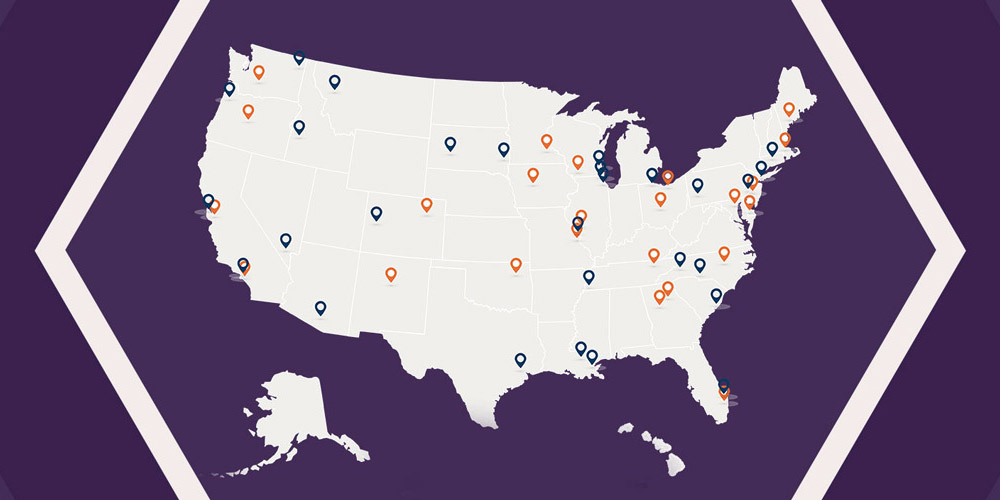
The SJC grew quickly during this period. Twenty cities and counties joined in 2015, 20 more communities joined in 2017, and 12 additional sites in 2018. By the end of this period, the SJC represented 52 cities and counties across 36 states, spanning from dense, diverse urban centers to small suburban towns.
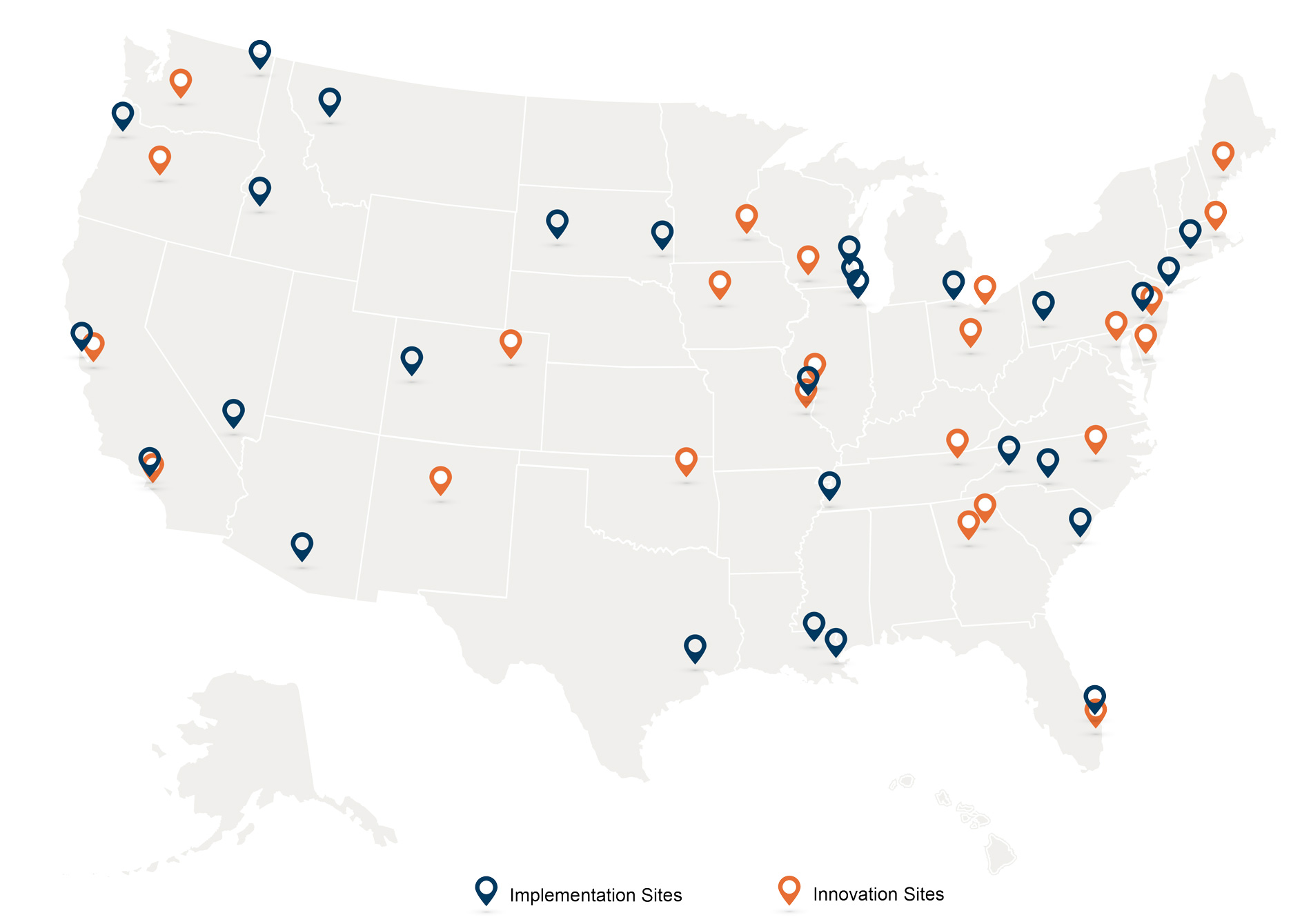
A map of cities, counties, and states that participated in the Safety and Justice Challenge. Blue markers represent communities that received deeper support directly from MacArthur, while orange markers represent communities that received support for smaller reform projects.
The specific reforms pursued by each community varied based on local context and need, including the expanded use of citations to reduce unnecessary arrests, increasing the availability of attorneys for defendants at their first court appearance, and more efficient case processing to minimize pretrial detention. Cross-agency collaboration to reduce jail use became standard practice, and many sites credited their participation in the SJC with notable improvements in data quality, collection, and access.
Raising public awareness was important as well. The SJC partnered with communications and media organizations to help Americans better understand local jails and their role in mass incarceration. Americans were discussing criminal justice reform more than ever before, and public understanding of mass incarceration increasingly emphasized the role of local jails. Expectations and attitudes shifted meaningfully across many facets of the system, including new standards for the conduct of elected prosecutors, police officials, and other local leaders. At the same time, public opinion research also surfaced skepticism toward alternatives to jail and perceptions of fairness that varied significantly by race.
Phase 2: 2019-2025
In 2019, the Safety and Justice Challenge collaborated with RTI International on a strategy review to evaluate and learn what was working, what was not, and why. The review sharpened our focus on two goals: meaningful community engagement and the reduction of racial and ethnic disparities in jail populations.
While SJC sites made real progress on safely shrinking jail populations, the disproportionate impact of local justice systems on communities of color persisted. Fewer people incarcerated meant fewer people of color incarcerated, but they remained overrepresented.
In response, we encouraged communities participating in the SJC to consider new strategies to include more community-based experts and people with lived experience, believing that individuals who had experienced incarceration were best positioned to advocate for effective, sustainable solutions.
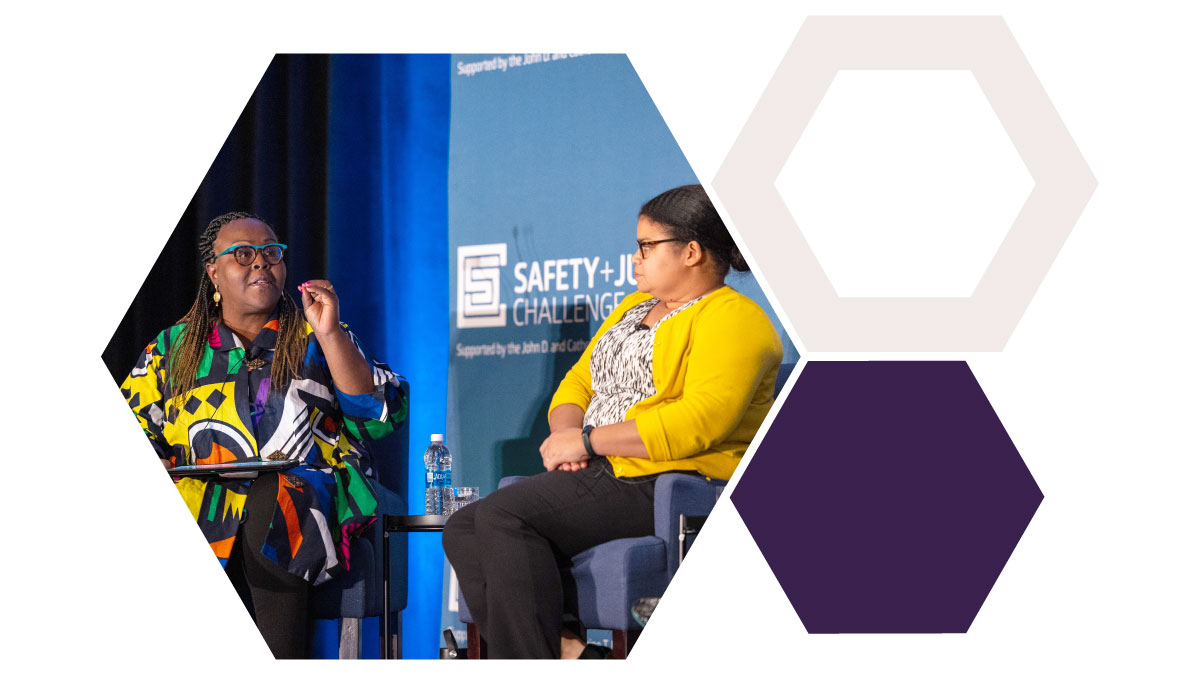
April Frazier Camara, President of the National Legal Aid and Defenders Association, speaks with Beverly Hauber, District Defender in St. Louis County, as part of a panel discussion at a SJC Convening in May 2023.
We also introduced peer-learning networks to help accelerate reform efforts. This included a Racial Equity Cohort to provide communities with training and expert assistance, peer-to-peer support from other cohort members, and qualitative and quantitative data and analytic support. Moreover, we added leadership development to support the criminal justice field, justice-impacted women, and survivors of violence. We also worked to expand access to safe and affordable housing for individuals exiting local jail systems to help break the link between jails and homelessness.
In the final years of the SJC, we shifted the focus from supporting cities and counties launching new strategies to helping sustain reforms with the greatest potential for lasting impact. SJC communities worked to secure local resources to retain key staff who were initially supported by SJC funding, to embed effective practices into ongoing operations, and to preserve the partnerships and collaboration essential to continued progress.
Measurement and Evaluation for Learning
Throughout the duration of SJC, we worked with our Evaluation and Learning Partners to assess the progress of our strategy, test the assumptions underpinning it, and collect information about the context in which our strategy operates.
With the help of RTI International from 2015 through 2019 and NORC from 2020 through 2026, we worked to ascertain to what extent the SJC was successful in reducing jail incarceration and addressing racial and ethnic disparities. We also examined the extent to which the initiative’s activities helped spread reform across the nation.
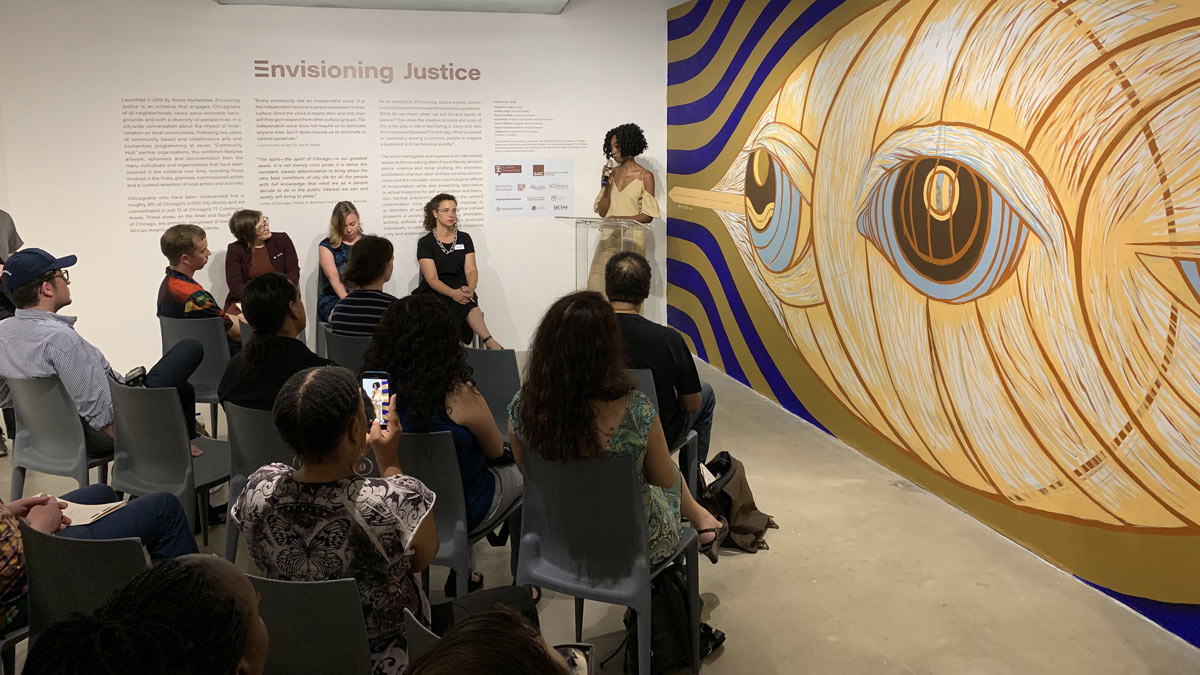
Curator Alexandria Eregbu speaks at an Envisioning Justice exhibit in 2019. MacArthur supported this two-year initiative by Illinois Humanities that used the arts and humanities to engage Chicago residents in conversation about the impact of incarceration on local communities.
While this work was not without its challenges—including leadership changes, shifting public opinions, sharp declines in funding, and the lasting effects of institutional racism in the criminal justice system—our Evaluation and Learning Partners found that cities and counties participating in the SJC successfully reduced jail populations. Through the implementation of local strategies across key criminal justice decision points, SJC communities’ achievements included:
- Developing and implementing over 300 reform strategies;
- Reducing overall jail population by nearly 20 percent in participating jurisdictions compared with approximately 9 percent nationally;
- Very low rates of return to jail for violent charges among people released pretrial in participating jurisdictions;
- Stronger coordination and collaboration among local justice agencies and community partners; and
- Greater local capacity to engage and respond to public discourse, as SJC partners developed new narratives and engaged trusted messengers, even in the absence of a unified initiative-wide communications strategy.
We built peer networks, broadened our community, and brought our grantees together to foster greater learning and sharing of resources. Our partners researched, synthesized, and produced a comprehensive range of publications on every facet of local jail reform.
Grantmaking Highlights
Ten Years of Building Safer, Fairer Justice Systems
November 17, 2026
Connecting Communities to Build Better Justice Systems
November 17, 2026
Three Key Lessons from the Safety and Justice Challenge
November 17, 2026
Illinois Bail Reform Makes Justice System More Equitable and Fair
September 18, 2023
We Can Reduce Jail Populations and Keep Communities Safe
April 5, 2023The Power of Community
January 18, 2023Program Evaluations
Additional Resources

Staff
- Nida Abbasi, Senior Program Officer, Criminal Justice
- Coralie Bauduy, Coordinator, Criminal Justice
- Valerie Chang, Managing Director, Programs
- Maurice Classen, Program Officer, Criminal Justice
- NeAngela Dixon, Senior Program Officer, Criminal Justice
- Janice Dunbar-Travis, Senior Grants Manager
- Aisha Edwards, Senior Program Officer, Criminal Justice
- Patrick Griffin, Senior Program Officer, Criminal Justice
- Laurie Garduque, Director, Criminal Justice
- Bria Gillum, Senior Program Officer, Criminal Justice
- Quinn Hanzel, Senior Grants Manager
- Lara Kalwinski, Associate General Counsel
- Jorge Lopez, Senior Associate General Counsel
- Mary McClanahan Thiel, Coordinator, Criminal Justice
- Soledad McGrath, Program Officer, Criminal Justice
- Stephanie Platz, Managing Director, Programs
- Maurice Samuels, Senior Evaluation Officer
- Maria Speiser, Senior Communications Officer
- Gabriela Suarez, Senior Grants Manager
- Erica Twyman, Senior Administrator, Criminal Justice
- Julian Williams, Senior Evaluation Officer