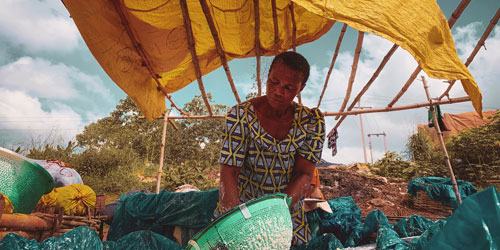







Action Health Incorporated, ActionAid Nigeria, and Partnership for Child Development, among others, supported schoolchildren’s health and boosted community economies.
In 2005, the Nigerian government introduced an initiative in 12 states to enhance children’s overall health and boost enrollment and educational outcomes. Known as the Home Grown School Feeding Programme (HGSFP), the effort also had another objective: work with local farmers, cooks, and food vendors to foster community economic growth.
But the program ran into challenges early. Beset by accountability issues, inadequate monitoring and evaluation, disbursement difficulties, and limited community involvement, it was suspended a few years in. Over the next decade, the number of children who were out of school in Nigeria had grown to more than 10 million, and amidst a change in administration, the Nigerian government reintroduced the program.
This time three organizations—Action Health Incorporated, ActionAid Nigeria, and the Partnership for Child Development (PCD), among a multitude of others—began providing support to strengthen the program’s administration, transparency, and accountability. These organizations had a bird’s eye view of the work. Additional groups supported over the years included: Centre for Women’s Health and Information (CEWHIN), Connecting Gender for Development (COGEN), Federation of Muslim Women Associations in Nigeria (FOMWAN), Girl Child Concerns, Nigerian Popular Theatre Alliance, and Women’s Consortium of Nigeria (WOCON).
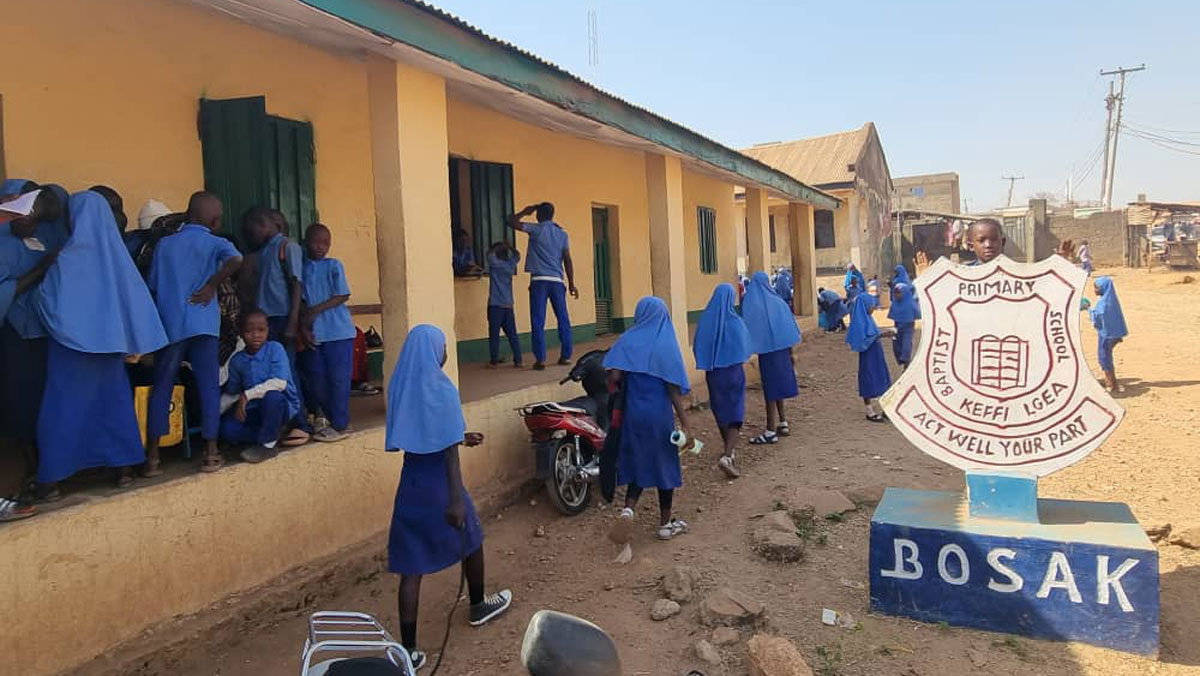
Baptist Primary School in Keffi in central Nigeria was a beneficiary of the school feeding program. Credit: Home Grown School Feeding and Health Programme.

“PCD supported improved transparency and reduced corruption within the system.”
Together, the results were more promising and showed the progress of the HGSFP, noting that:
- Nearly 9.9 million pupils in more than 56,000 public primary schools across 33 Nigerian states benefitted from the program.
- Approximately 107,000 cooks participated, the vast majority of whom were women and for whom this was an important income-generating opportunity.
- More than 150,000 small holder farmers supplied locally sourced ingredients to the program.
“What PCD did was to lead the process of achieving HGSFP at a national scale within the auspices of the Vice President’s offices,” said Lesley Drake, Executive Director of the Partnership for Child Development (PCD), a nonprofit addressing the health, nutrition and education needs of school-age children and adolescents in low and middle-income countries. PCD provided technical assistance in key areas, ensuring that the federal government could systematically integrate, scale up, and strengthen school health policies and programs in a cost-effective and sustainable manner nationally, Drake said.
“PCD supported improved transparency and reduced corruption within the system,” she said.
She added that the cash-based format of the initial program was a fundamental flaw that led to corruption and its collapse.
Transparency, Technical Support, Smartphones
To bolster the initiative, PCD reviewed the program and provided technical support to define a specific national strategy for implementing the program. The strategy included delineating roles and responsibilities of participants and creating a robust monitoring and evaluation system. The support also helped establish procurement and meal planning systems and a financing platform to increase transparency and reduce corruption risks.
ActionAid International Foundation Nigeria, part of a global organization to promote human rights and eradicate poverty, supported officials of agencies in charge of the feeding program to improve its administration, collaboration, and inter-agency coordination. ActionAid also trained community organizations to monitor, track, and report food deliveries—in part by utilizing smartphones to forward real-time data—to improve the program’s overall accountability.
Action Health Incorporated—which works to promote young people’s health and development—and other civil society organizations monitored the feeding program in 60 schools and created a handbook for other community accountability partners who monitored and maintained transparency.
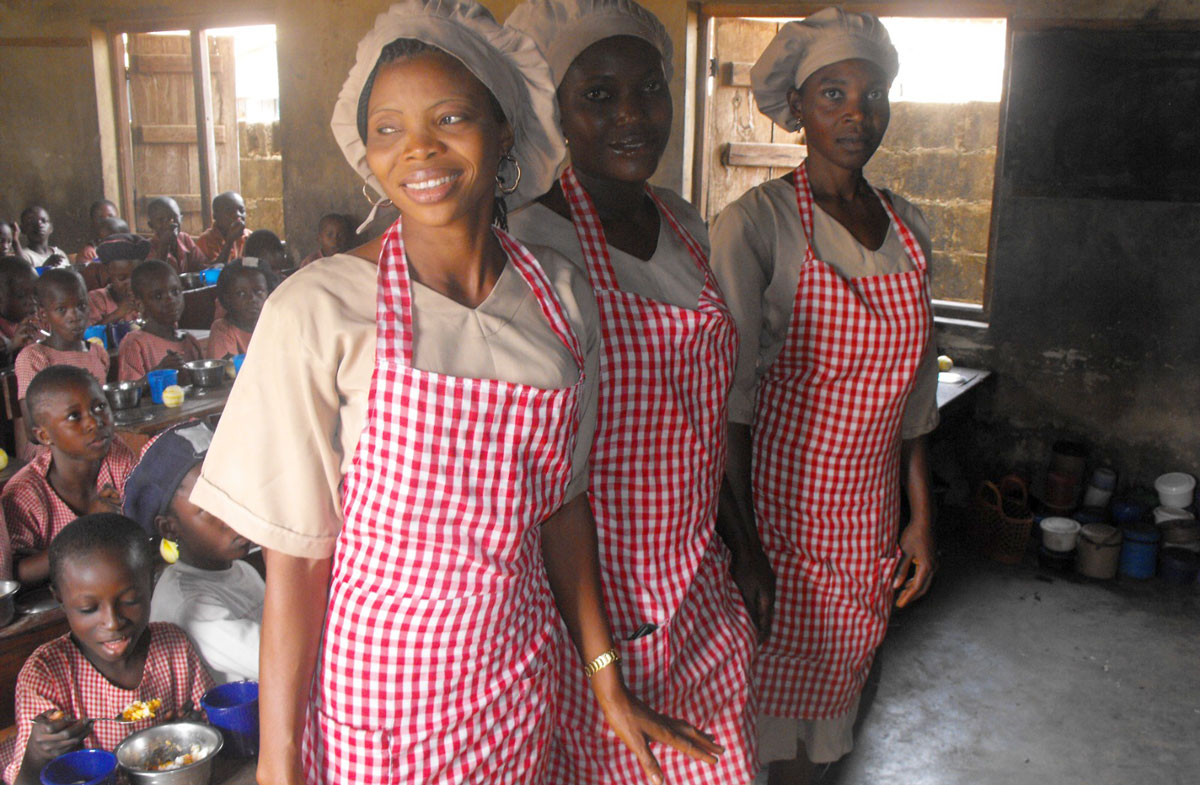
About 107,000 cooks were employed in the school feeding program, supporting the initiative’s goal of fostering community economic growth. Credit: Partnership for Child Development.
“Community members were involved, such as school based management committee members, parent teachers associations, teachers, community leaders, parents of beneficiaries of the program, and community-based organizations,” said Action Health Incorporated Executive Director Adenike Esiet.
Children’s enrollment in public schools in the west-central state of Niger rose to nearly 78 percent, up from 54 percent five years earlier, said Umar Shaba, program manager of the state’s school feeding program.
“In some cases,” he said, “even those not enrolled in school wanted to go to school simply because they knew there would be breakfast.”
Community Economic Benefit
Wider benefits were reported among farmers in Nigeria who had participated in the school feeding program—about 40 percent of beneficiary farmers were food secure, or had access to enough food for a healthy life, compared to 20 percent of the farmers who were not beneficiaries of the program.
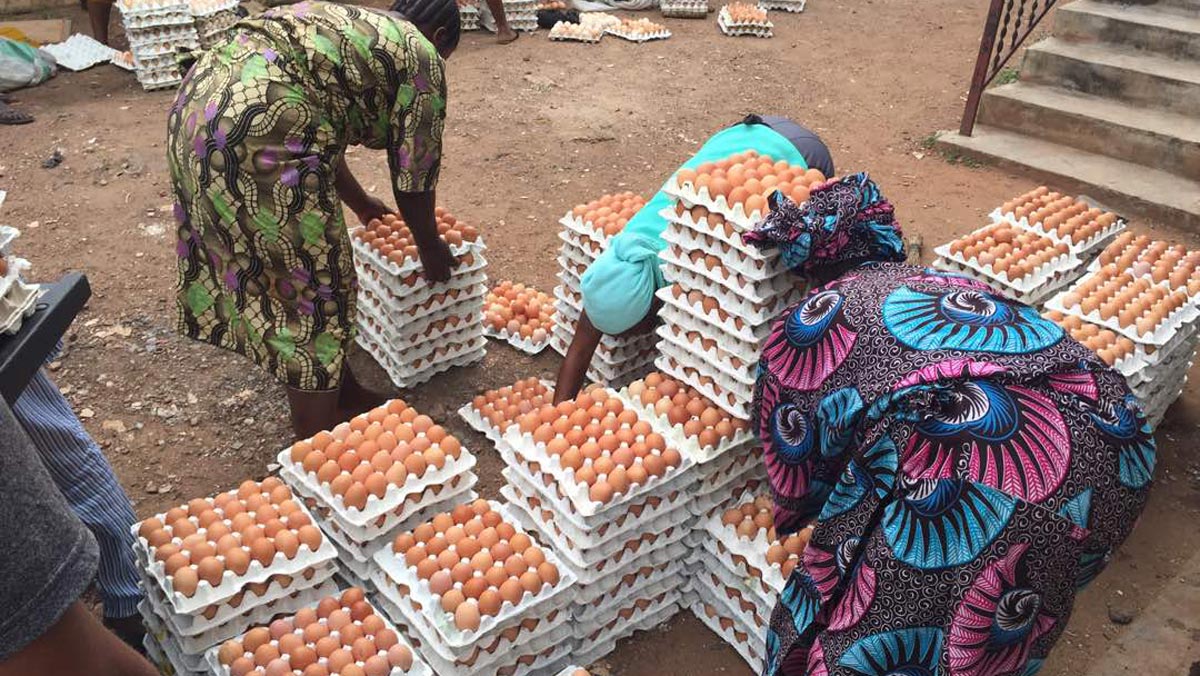
Farmers prepare eggs for delivery as part of the feeding program, which boosted egg production and enhanced food security for participating farmers. Credit: Partnership for Child Development.
Poultry farmer Hajia Binta Adamu was among those who benefited.
“The program boosted my productivity on the farm," said Adamu, who was the program’s egg aggregator in Kaduna state. "From rearing 3,000 birds before the commencement of the program, I moved gradually to 8,000 and then to 20,000 birds within three years.”
“The program boosted my productivity on the farm.”
Adamu attributed the success of the school feeding program in Kaduna and other states to the strong monitoring and oversight provided by PCD and other partners.
However, the impact of administrative changes in the Nigerian government, the COVID-19 pandemic, and the end of philanthropic support led to the discontinuation of the school feeding program in 2022. Today, the program has been re-structured under the name Renewed Hope-Ni and awaits sufficient funding.
But the program’s substantial improvements—personified by the enhanced lives of millions of schoolchildren and economic opportunity for more than 200,000 small holder farmers and cooks, more than 90 percent of whom were women—underscore the crucial efforts of Action Health Incorporated, ActionAid Nigeria, the Partnership for Child Development, and other civil society organizations. In Ogun State, positive changes that resulted from Action Health Incorporated’s interventions across 60 schools included stronger collaboration and trust between government and communities, the establishment of Community Accountability Watch Groups to demand greater compliance from cooks on ensuring meals were prepared safely and with adequate portion size, real-time monitoring to address issues and clarification of payment processes for vendors and cooks.
Those improvements also serve as a substructure that can be expanded into a more comprehensive, enduring school feeding program.
Between 2017 and 2020, MacArthur provided $1.7 million for ActionAid International Foundation Nigeria and $610,000 to Action Health Incorporated to track and improve the Home Grown School Feeding and Health Programme.
Between 2016 and 2019, MacArthur provided $1.2 million for the Imperial College London/Partnership for Child Development.