






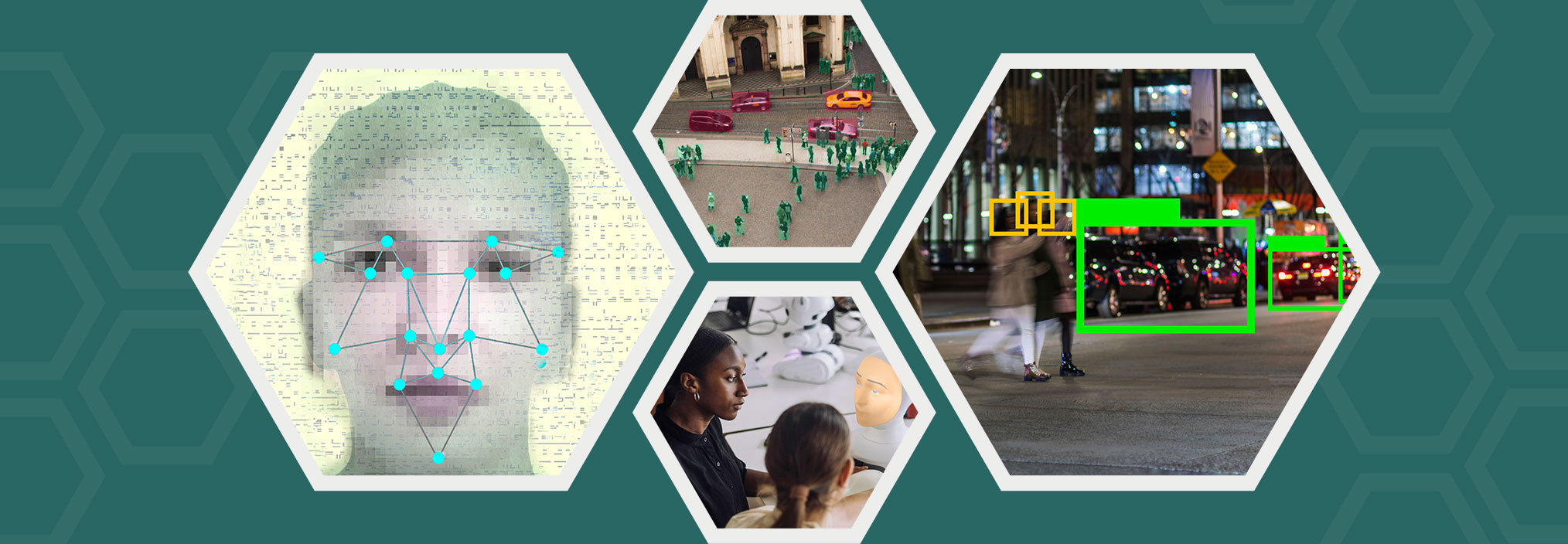
Trinity College AI Accountability Lab centers public interest and societal good in evaluating artificial intelligence technology.
About halfway through her PhD work in cognitive science, Abeba Birhane found that her passion in the field was shifting away from that specific discipline. Increasingly concerned about biased and inaccurate data baked into artificial intelligence (AI) systems, she began focusing on evaluating and auditing AI training models.
“I was much more interested in critically analyzing and investigating AI systems that have real consequences on actual people in the real world,” Birhane said. “And this kind of work was much more rewarding, but also it has immediate consequences for people, for marginalized communities, and for society in general.”
She became a cutting-edge AI evaluator and has made it her life’s work to show that human decisions shape the way these models are designed and trained.
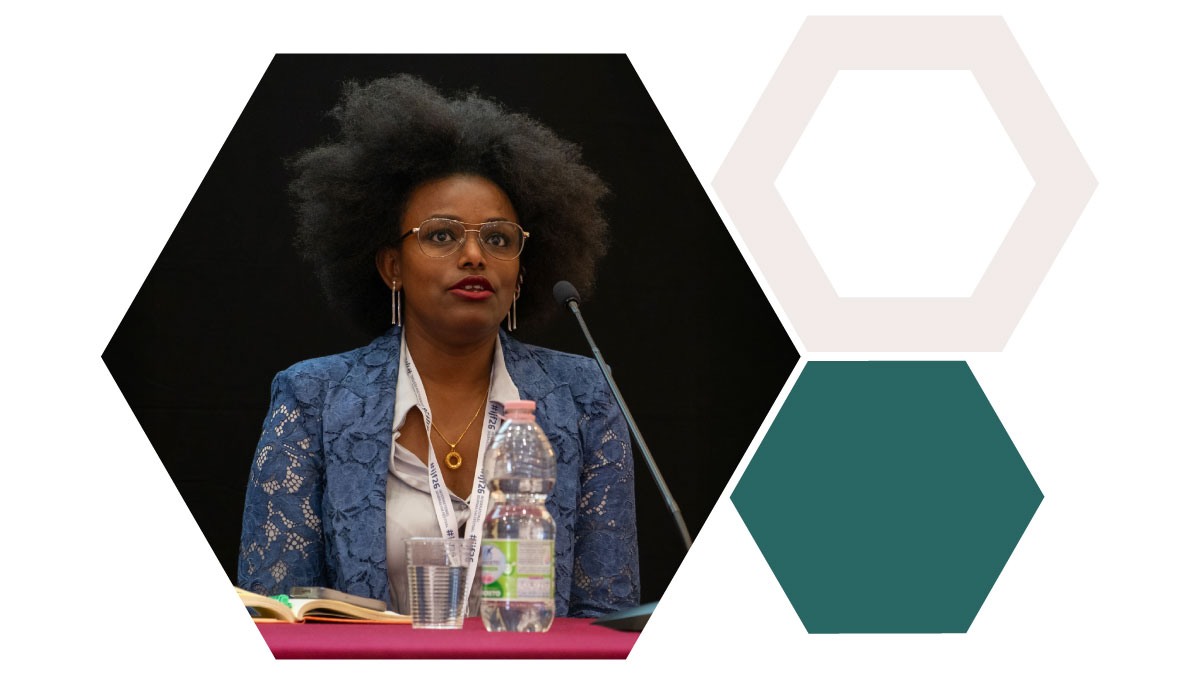
Abeba Birhane speaks at a panel at the 2026 International Journalism Festival. Credit: Elena Vasquez/International Journalism Festival
To better understand AI systems’ real-world impact, Birhane founded the Artificial Intelligence Accountability Lab (AIAL) at Trinity College Dublin in 2024. The Lab’s work focuses on evaluating AI systems, determining how models’ training can produce harmful results, and dismantling harmful technologies.
The Lab’s overarching mission is to make sure that AI centers public interest and societal good—particularly considering people who are the most marginalized and disenfranchised—over corporate profit. Birhane has—among other work—researched and written about datasets packed with pornographic and misogynistic stereotypes, the algorithmic colonization of Africa, AI’s capacity to distort human beliefs, and hate festering in multimodal datasets.
Central to its work is transparency and holding the actors designing, deploying, and integrating the systems accountable.

“AI is a product that is inherently intertwined with critical societal infrastructures.”
“AI is a product that is inherently intertwined with critical societal infrastructures,” said Birhane. “I feel that it's really important to interrogate how this product works, to ensure that the claims being made by AI companies and vendors actually stand up to scrutiny. That's what we are trying to do at the Lab.”
AIAL performs its work by collaborating with researchers, civil society, and rights groups across the globe—a strategy that gives the Lab the weight needed to advance its mission.
In doing so, Birhane and the Lab are strengthening their approach to evaluate these AI systems based on their impact on the greater good, not their growth or popularity.
“Many issues of technology and access stem from a need to be able to believe that our voices matter and not experiencing that,” said Zeerak Talat, a Chancellor’s Fellow in Responsible Machine Learning and Artificial Intelligence at the University of Edinburgh. “That is why the work that Abeba and her lab are doing is so important. It provides an alternative model for our voice mattering. It makes space for hope.”
Broader, Transparent Understanding
Abuses in AI are becoming well known. They include biased facial recognition technologies that lead to wrongful arrests and algorithms that weed out people from jobs, government aid, or healthcare based on race, sex, age, or other discriminatory factors.
In response, The European Commission in 2024 adopted the EU Artificial Intelligence Act. It established initial rules on identifying high-risk AI systems and the dangers they pose to society, especially to marginalized groups. While the Act provides a structure for identifying potential public harm, the standards are being watered down under growing pressure from Big Tech and other actors.
Researchers working on the societal impacts of AI—becoming increasingly woven into everyday life—say now is the time for a broader, more transparent understanding of how the systems and their training data work and impact peoples’ lives.
AIAL, one of the few independent sources of research into AI’s societal risks, conducts testing that is a model for evaluating systems before they are released to the public.
“When these systems fall short of satisfying a given criteria, then we have to be able to say to these vendors, ‘This is not up to standard,’” Birhane said. “‘And you have a responsibility and an accountability for the harms that these systems may cause.’”
“What kind of research ecology and product development might we see if it were geared towards public benefit…”
Still in its early stages, the Lab’s impact centers on conducting empirical research to influence policy in Europe and Africa and collaborating with research and policy organizations to strengthen international accountability and policy.
Among other efforts in that brief time, AIAL has produced a groundbreaking analysis of computer vision use showing a close, but hidden, relationship between AI’s visual recognition industry and expanding human surveillance. The Lab has also studied terms of use of six generative AI services and their implications on the rights of EU consumers.
“What is most exciting about Abeba’s lab is that it’s giving the field the freedom to ask, ‘What kind of research ecology and product development might we see if it were geared towards public benefit and not just the bottom lines of a few tech giants?’” said Amba Kak, Co-executive Director of AI Now Institute, which focuses on AI policy research.
Since 2024, MacArthur has provided $400,000 to Trinity College Dublin to support the establishment of the AI Accountability Lab within the School of Computer Science and Statistics, which aims to produce evidence-based research toward a critical examination of the artificial intelligence field to identify and mitigate harms and inform both regulation and public understanding.