





 Location
 Age
Age Area of Focus
 Website(s)
 Social
About Vincenzo's Work
Vincenzo Vitelli is a physicist building theoretical frameworks to describe the behavior of matter and materials with unique properties. Vitelli extends tools and principles from theoretical physics, engineering, and topology to investigate a range of classical, mechanical, and active materials, including metamaterials and soft matter. His insights allow for deeper understanding of real-world biological and engineering systems and lay the groundwork for entirely new classes of materials.
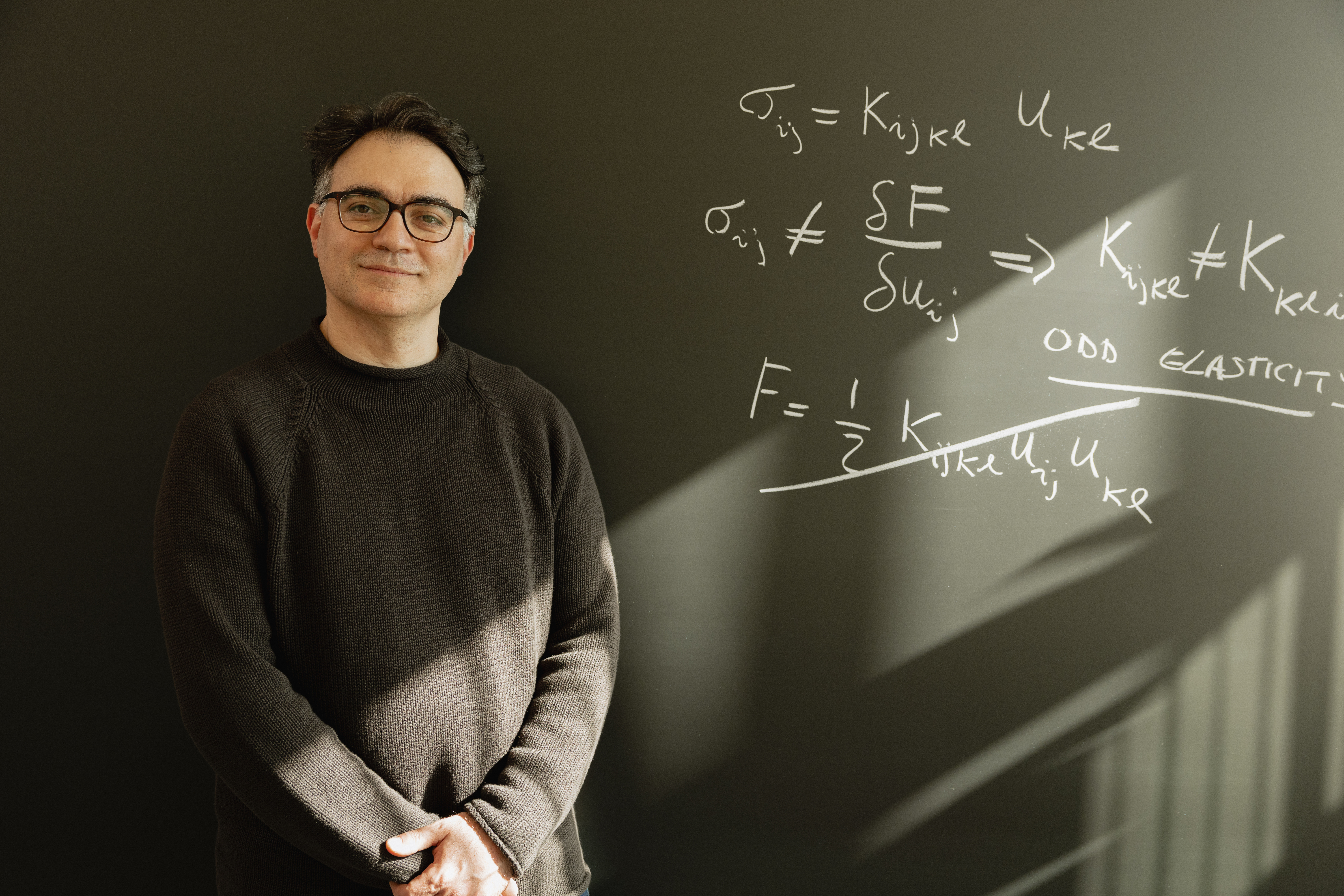
In early work, Vitelli pioneered the application of topological concepts to mechanical metamaterials, artificial materials engineered to have mechanical properties that natural materials do not, like manipulating light or sound waves. Topology is the mathematical study of properties of objects that stay the same when the objects are bent, twisted, stretched, or otherwise deformed. Vitelli showed that extensions of the topological description of the flow of electrons in quantum physics can be used to design mechanical metamaterials that embody distinct properties. For example, he demonstrated that mechanical lattices can possess hidden symmetries called self-dualities and behave as topological insulators for sound waves. The symmetries of such materials protect sound waves that move along their boundaries, so that the sound waves remain robust and unchanged even when faced with obstacles. Vitelli has also advanced the understanding of non-reciprocal active matter. Active matter encompasses diverse systems made of individual, energy-harvesting components, such as living tissues, flocks of birds, and robotic swarms. In many instances, the individual components of active matter do not react to a perturbation with an equal and opposite reaction; these non-reciprocal interactions confer unique mechanical properties to active matter. Vitelli introduced the concept of “odd elasticity” to describe how non-reciprocal, soft, active matter responds to deformations. Under normal conditions, deforming soft matter in one direction will cause it to deform perpendicularly: squeezing the sides of a square sponge will make it stretch vertically into a rectangular shape. Vitelli showed that in non-reciprocal active matter, deforming an object in one direction can cause deformations in many directions. So, squeezing a biological tissue or a robotic swarm could make it stretch vertically and diagonally, as well as undergo self-sustained cycles of deformations.
Beyond active matter, Vitelli found that non-reciprocal systems can exhibit phase transitions that are governed by internal dynamics rather than external perturbations. For example, he discovered how the transition from static (at rest) to dynamical (in motion) phases is largely determined by the degree to which the components’ responses to perturbations are asymmetric. Vitelli’s research is inspiring new metamaterials in mechanical engineering, robotics, and biophysics, and he is opening up new research directions into how non-reciprocal physics principles could apply to biology, human behavior, and artificial intelligence.