
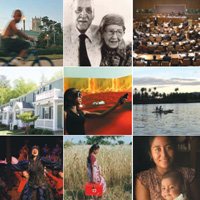
About John D. & Catherine T. MacArthur
The name John D. MacArthur is well recognized, as the Foundation he and his wife, Catherine, created provides approximately $300 million annually to nearly 500 effective organizations helping to build a more just, verdant, and peaceful world. But in post–World War II America, when MacArthur earned his millions, he was the least known of the nation’s wealthiest men.
Even after he earned his great wealth in insurance and real estate, MacArthur lived in relative simplicity with Catherine at a Florida hotel he owned, and he often boasted that he did not know his own financial worth. When he died in 1978, he left over $1 billion in assets to the John D. and Catherine T. MacArthur Foundation. Today, the MacArthur Foundation is one of the largest private foundations in the world.
John D. MacArthur rose from humble means to become one of the richest men in America. Born on March 6, 1897, in Pennsylvania, MacArthur was the son of an itinerant Baptist preacher and missionary who expected his seven children to be devout Christians. The family never had much and moved frequently because of the father’s work. By the time MacArthur was 16, he had left school and moved to Chicago where he worked with an older brother in the insurance industry. This career move paid off. At just 19, John sold more than $1 million in insurance in one year.
In 1928, MacArthur purchased his first insurance company, Marquette Life, at 140 South Dearborn Street, in the same Marquette Building where the Foundation is now headquartered. A decade later, he bought Bankers Life and Casualty Company, which quickly became the centerpiece of his emerging business empire. The company succeeded because of his simple, but revolutionary, idea: door-to-door salesmen were replaced with mass marketing techniques to keep down cost and make coverage affordable for the “everyday man.” By 1956, Bankers Life was the largest health and life insurance company in the United States.
John met Chicago-native Catherine Hyland at his brother’s insurance company where she worked as a secretary. Catherine, one of five children, was raised on the South Side by Irish immigrant parents. John was the public face of their business ventures, while Catherine often worked behind the scenes, tracking details and accounts. He always acknowledged Catherine’s role in his business success. “She helped build it up,” he said of her when drawing up the paperwork to create the MacArthur Foundation.
After building their fortune together and making a home in Chicago, the couple moved to Florida in 1958. There, the MacArthurs began to accumulate their vast real estate holdings. By the time John died, he had purchased more than 100,000 acres of Florida land. He also bought the Colonnades Hotel on the south end of Singer Island; located on a breathtaking stretch of beach, it became the couple’s home. A table in the Colonnades coffee shop served as his office. Indeed, he was often mistaken for the hotel handyman. Media called him “the accessible billionaire.”
Despite a frugal lifestyle, the MacArthurs quietly donated to worthy causes, including the North Palm Beach YMCA and Palm Beach Atlantic University. They made the ballroom at the Colonnades available free of charge for charitable causes.
John’s longtime friend and attorney William T. Kirby convinced him that a foundation would allow his money to go to good use long after he was gone. On October 18, 1970, the documents for the John D. and Catherine T. MacArthur Foundation were completed. John intentionally left the business of what to fund to the Foundation’s first board of directors, which included Catherine; Kirby; his son, Roderick; radio commentator Paul Harvey, a friend from Chicago whose popular program carried ads for Bankers Life; and Louis Feil, a business associate from New York. “I made the money; you guys will have to figure out what to do with it,” MacArthur told the board. This direction presented the Foundation’s first board with two challenges: how to divest responsibly the assets and how to shape a forward-looking organization that could change with society’s evolving challenges.
When John died of cancer on January 6, 1978, the Foundation assumed his assets, estimated at $1 billion. In less than a year, the board began to award grants. Early grant recipients included Amnesty International and the John D. MacArthur Beach State Park. Thirty years after John’s death, the Foundation the MacArthurs created has provided nearly $4 billion in grants in the United States and more than 60 countries around the world.
A Global Foundation
30 years of grantmaking
58 countries where MacArthur supports work
5 offices
7,100 grant recipients
$3.8 billion in grants awarded

MacArthur offices (west to east):
Mexico City, Mexico
Chicago, United States
Abuja, Nigeria
Moscow, Russia
New Delhi, India
Countries where MacArthur supports work:
|
Afghanistan |
Egypt |
Lithuania |
Sierra Leone |
30 Years at a Glance
Foundation Assets (in billions)

A $7 billion foundation
Annual Grantmaking (in millions)

Approximately $300 million in annual giving
Cumulative Grantmaking (in billions)

Nearly $4 billion in total giving
Cumulative Number of Grants Awarded

More than 18,500 grants awarded to more than 7,100 individuals and organizations
1978-2008
1970
John D. and Catherine T. MacArthur and Paul Doolen sign documents establishing the MacArthur Foundation.
1978
After John D. MacArthur’s death, the Foundation takes on assets of Bankers Life, estimated at $1 billion. Assets from Citizens Bank and Trust Company of Park Ridge establish the Retirement Research Foundation.
Board awards first grants to Amnesty International and California League of Cities.
1979
MacArthur Fellows Program is established to provide five years of no-strings-attached support for the recipients.
Health Program is set up to focus on issues in mental health. Over first two years, $15.2 million in grants doubles private-sector funding for the field.
Special Grants Program (later named Community Initiatives Program) is formed to support Chicago cultural and community activities.
General Grants Program begins, supporting areas of interest not addressed by the Health, Fellows, or Special Grants programs.
1980
$1 million grant helps establish Chicago office of Local Initiatives Support Corporation to improve low-income neighborhoods.
Expressing its belief in literary excellence, especially in writing about public policy, the humanities, and the arts, the Foundation devotes $12.5 million to the rescue of Harper’s Magazine.
Foundation gives 82 acres of prime oceanfront property in Palm Beach County, valued at $22.1 million, to the state of Florida for John D. MacArthur Beach State Park.
1981
Catherine MacArthur dies of cancer, leaving part of her estate to charity, including $12 million to Palm Beach Atlantic University.
First class of MacArthur Fellows is announced with awards to 41 people, including poets and physicists, novelists and historians, an arts educator, and a social activist.
1982
Foundation grants are used to establish the World Resources Institute, which would educate decision makers about the scientific basis for global warming, among other contributions. Grants to WRI ultimately total more than $43 million.
1983
A major initiative is launched to fight parasitic diseases, which afflict more than half the world’s population. The investment brings fundamental new approaches to research on these diseases.
The first research networks are created to investigate the roots of mental health and illness. A total of 24 Foundation networks unite scientists, practitioners, and policy experts and shed light on areas ranging from human development to economics.
Support for Chicago’s ShoreBank, the nation’s first and largest community development bank, marks beginning of more than $275 million of program-related investments.
1984
Bankers Life and Casualty Company, the main asset left to the Foundation by John D. MacArthur, is sold.
Program on Peace and International Cooperation is created to strengthen and broaden the understanding and practice of peacemaking and international security.
1985
The Foundation creates the Fund for Neighborhood Initiatives, a program aimed at revitalizing some of Chicago’s poorest communities. In its first year, the program distributes grants totaling $720,000 to 30 neighborhood groups.
The Foundation sells 11 properties in New York City for $500 million, the largest sale of residential real estate in the city’s history.
1986
MacArthur begins supporting the work of PBS’s Bill Moyers through a $5 million grant for the series A World of Ideas.
More than $9 million is awarded to conservation groups to stimulate long-term solutions to the global ecological crisis. The resulting work is central to the development of the new concept of global biodiversity, which now underpins most large-scale conservation efforts.
Research and Writing Competition is launched to support independent scholars and analysts writing on issues of peace and international cooperation. Over its 18-year history, the Competition awards more than 600 grants totaling nearly $35 million to researchers in 52 countries.
1987
MacArthur is a founding funder of P.O.V., the PBS program that becomes the longest-running television showcase for independent documentary storytelling.
Education Program is created to advance literacy, numeracy, and critical thinking.
U.S. Tropical Initiative focuses on endangered tropical ecosystems in U.S. — Hawaii, Puerto Rico, Florida Keys, and U.S. Virgin Islands.
1988
Health Program launches a research initiative in mental health law, which leads to a better understanding of the link between mental health and violence in the community.
1989
World Environment and Resources Program is created to focus on conservation issues worldwide.
Population Program is created to address the challenges posed by population growth and meeting the reproductive health needs of the developing world.
$40 million over 10 years is committed to Chicago’s school reform initiative.
1990
The Foundation receives the George Foster Peabody Award for supporting “inventive, inspired and important television.”
Three foundations, MacArthur, Pew, and Rockefeller, create the Energy Foundation to advance energy efficiency and renewable energy.
Foundation launches decade-long Project on Human Development in Chicago Neighborhoods, the largest research study to date on the impact of neighborhood changes and the psychological development of young people.
Fund for Leadership Development is created to support emerging leaders in the developing world working on population, reproductive health, and natural resource management.
1991
Grants to build partnerships among neighbors and police form a research and demonstration base that leads to community policing in Chicago.
1992
Responding to the post–Cold War opportunities, the Foundation creates a major initiative in the former Soviet Union to support Russia’s academic and scientific infrastructure.
Offices are opened in Mexico and Russia.
1993
Researchers in MacArthur’s Network on Successful Aging report that most of the factors that predict successful aging are not solely genetic but at least equally related to lifestyle. The Network later produces a best-selling book, Successful Aging.
1994
U.S. Cooperative Threat Reduction Program is established, reflecting proposals of a consortium supported by MacArthur and the Carnegie Corporation aimed at encouraging joint U.S.-Russia work to dismantle nuclear weapons and secure fissile material.
Foundation opens offices in India and Nigeria.
1995
Large-scale research initiative launched to change the discourse about equality and decision making in the field of economics.
1996
MacArthur awards an initial grant to the Coalition for the International Criminal Court to coordinate activities of human rights and other non-governmental organizations working to establish the International Criminal Court.
Foundation begins supporting research on adolescent development and juvenile justice.
1997
Board of Directors endorses a new program structure for the Foundation, with the majority of grantmaking to be carried out through two integrated programs: the Program on Human
and Community Development and the Program on Global Security and Sustainability.
1998
Biodiversity conservation work expands with a new initiative in Africa that focuses on the Great Lakes of East Africa, Madagascar, and the Central African forest belt, joining earlier commitments to protect hotspots in Asia and Latin America.
The Foundation provides support for civil society organizations from developing countries to attend the Rome Diplomatic Conference on the International Criminal Court.
1999
Foundation supports ambitious $1.3 billion Plan for Transformation of public housing
in Chicago with the goal of developing new mixed-income communities and helping residents improve their lives.
2000
Foundation creates the Partnership for New Communities to galvanize civic and corporate support for the Plan for Transformation of Chicago’s public housing.
MacArthur provides the first of a series of grants to human rights groups to support activities related to the prosecution of former Chadian dictator Hissène Habré on charges of crimes against humanity and as an accomplice to torture.
MacArthur partners with the Carnegie, Ford, and Rockefeller Foundations to commit $100 million to strengthen higher education in Africa. Funding is increased to $350 million in 2005.
2001
Models for Change, the Foundation’s juvenile justice reform initiative, begins with an initial commitment of $40 million, which is increased to $100 million in 2006.
2002
The Responsibility to Protect, a report by a Foundation-funded international commission, creates a new norm for humanitarian intervention.
In celebration of its 25th anniversary, the Foundation authorizes $42 million in unsolicited grants to arts and culture organizations in Chicago and South Florida and to several major national and international organizations.
Foundation becomes founding partner of the Critical Ecosystems Partnership Fund with a grant of $25 million to strengthen biodiversity preservation in threatened areas.
2003
$50 million contribution launches Window of Opportunity, an initiative to preserve and improve affordable rental homes across the country. Funding is increased to $150 million in 2007.
In partnership with the Chicago office of the Local Initiatives Support Corporation, MacArthur creates the New Communities Program, an effort to improve 16 low-income Chicago neighborhoods.
First research grant awarded to assess the anti-shock garment, a lower body suit that helps stop postpartum hemorrhage. In 2007, the Foundation expands support for the garment and a broader package of interventions against this leading cause of maternal death in the developing world.
MacArthur Funds for the Arts created at the Prince Charitable Trusts and the Richard H. Driehaus Foundation to provide operating support to small and mid-size Chicago-area arts groups.
National Public Radio receives $14 million from the Foundation, the largest grant in
NPR’s history.
2004
In partnership with the Rockefeller Foundation and the governments of Norway and Canada, MacArthur helps to launch Security Council Report, an independent source of information on
the UN Security Council.
Science, Technology, and Security Initiative is launched to encourage a new generation of scientists and technicians to address the threat posed by weapons of mass destruction.
Foundation awards $20 million to the Community Foundation of Palm Beach and Martin Counties to create the John D. and Catherine T. MacArthur Fund for grant-making in the arts, education, community development, and the environment.
2005
The U.S. Supreme Court, citing the work of the MacArthur Research Network on Adolescent Development and Juvenile Justice, outlaws the death penalty for juveniles.
2006
Four-year restoration of the historic Marquette Building, the Foundation’s headquarters, is completed. Work includes re-creating the cornice, restoring the façade, and reconstructing the original windows.
The Foundation launches a new initiative on Global Migration and Human Mobility.
Nine organizations in five countries are selected to receive the Foundation’s first annual MacArthur Award for Creative and Effective Institutions.
New project on the power of measuring social benefits seeks to improve public policymaking through understanding how social policies that invest in individuals in need can benefit society at large.
MacArthur starts Research Network on Advancing Conservation in a Social Context and a five-year effort to develop experimental approaches on adaptation of biodiversity conservation to climate change.
$50 million is committed to a new initiative to help understand how digital media is changing how young people think, learn, play, socialize, make judgments and participate in civic life, and implications for institutions like schools, museums, and libraries.
2007
Foundation commits $25 million to new research on the ways housing matters to children, families, and communities.
With MacArthur support, MIT Press launches the International Journal of Learning and Media, providing a scholarly vehicle and online community for the emerging field of digital media and learning.
$10 million MacArthur grant spurs the development of the Encyclopedia of Life, an unprecedented global effort to create Web pages for all 1.8 million known species on earth.
Foundation launches exploratory grantmaking to understand a role for philanthropy in virtual worlds.
With MacArthur support, the Law and Neuroscience Project begins, marking the first systematic effort to consider how courts should handle new brain imaging techniques as they apply to matters of law.
2008
In recognition of the Foundation’s 30th anniversary, the MacArthur Award for International Justice is awarded to former UN Secretary-General Kofi Annan.
MacArthur leads effort to create the 2016 Fund for Chicago Neighborhoods to ensure that the city’s Olympics bid provides lasting benefits to neighborhoods and local residents.
Foundation Leadership
Presidents
John E. Corbally
MacArthur Foundation President
1979–1989
Former President of the University of Illinois
As board member, and later as president, helped shape the Foundation’s intellectual, scientific, and research tone through early programs including the MacArthur Fellows, support for public radio, and investments in peace and security, mental health, and the environment.
Steered the board through the process of divesting Bankers Life and Casualty assets.
Adele E. Simmons
MacArthur Foundation President
1989–1999
Former President of Hampshire College
Established the Foundation’s global reach, opening offices in Russia to strengthen universities and policy institutes, and launching the Population Program with field offices in Mexico, Nigeria, Brazil, and India.
Increased collaboration with other foundations.
Completed the transfer of management from the board to the staff and combined nine separate Foundation programs into four — international, domestic, General, and Fellows.
Jonathan F. Fanton
MacArthur Foundation President
1999–present
Former President of New School University
Deepens investment in some of the Foundation’s most promising areas of work including human rights and international justice, juvenile justice, affordable housing, and community and economic development.
Seeks out and supports major new ideas, such as the Encyclopedia of Life and the Law and Neuroscience Project.
Emphasizes fewer grants but for larger amounts and longer periods of time to increase the impact of MacArthur’s grantmaking.
Board Members
Board Members
John D. MacArthur
1970–1978
Catherine T. MacArthur
1970–1981
Paul D. Doolen
1970–1984
Louis Feil
1970–1978
Paul Harvey
1970–2002
John Roderick MacArthur
1970–1985
Robert P. Ewing
1978–1996
Gaylord Freeman
1979–1986
Murray Gell-Mann
1979–2002
Edward H. Levi
1979–1984
Jonas Salk
1979–1995
William E. Simon
1979–1981
Jerome B. Wiesner
1979–1994
Weston R. Christopherson
1984–1986
Shirley Mount Hufstedler
1984–2002
James M. Furman
1985–2002
Margaret E. Mahoney
1985–2002
Alan M. Hallene
1987–2002
Adele Smith Simmons
1988–1999
Walter E. Massey
1989–1991
William H. Foege
1991–2005
John P. Holdren
1991–2005
George A. Ranney, Jr.
1991–2005
Thomas C. Theobald
1995–2006
Laura D’Andrea Tyson
1997–1999
Chairs
Paul D. Doolen
Chair: 1979–1984
Member: 1970–1984
Thornton F. Bradshaw
Chair: 1986–1988
Member: 1985–1988
William T. Kirby
Chair: 1989
Member: 1970–1990
Elizabeth J. McCormack
Chair: 1990–1995
Member: 1986–2002
John E. Corbally
Chair: 1995–2002
Member: 1979–2002
Sara Lawrence-Lightfoot
Chair: 2002–2007
Member: 1991–2007
Robert E. Denham
Chair: 2007–present
Member: 2000–present
Current Board of Directors
Robert E. Denham
2000
Lloyd Axworthy
2000
Drew S. Days, III
1996
John Seely Brown
2000
Jonathan F. Fanton
1999
Jamie S. Gorelick
2001
Mary Graham
2001
Alan B. Krueger
2007
Mario J. Molina
2002
Jack Fuller
2005
Donald R. Hopkins
2005
William I. Miller
2005
Marjorie M. Scardino
2005
- Download MacArthur_30years.pdf (1.6 MB)